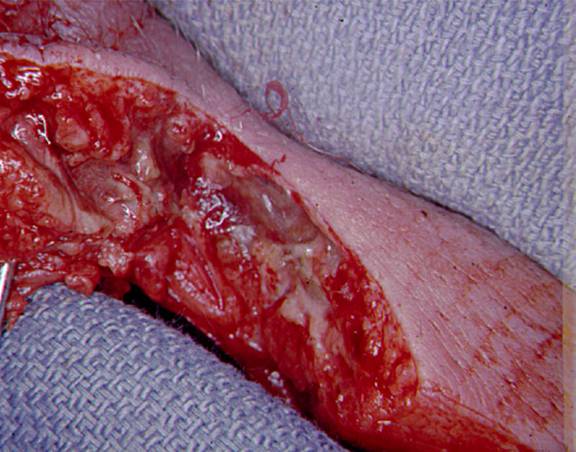
THIS IS IMPORTANT BECAUSE THERE ARE STILL PLACES WITH THIS TOXIC SLUDGE SPREAD OVER THEM...PLAYGROUNDS, CITY PARKS, HOME GARDENS, GRAZING FIELDS, FARMS, RANCHES, ETC, AND PEOPLE HAVE DIED FROM THIS SLUDGE, HAVE BECOME CHRONICALLY, EVEN TERMINALLY ILL FROM IT.
IF YOU RECOGNIZE AN AREA THAT HAS BEEN SPREAD WITH THIS KNOWN CARCINOGEN, AND RECOGNIZE THE SYMPTOMS, IT MAY YET SAVE LIVES.
PLEASE READ CAREFULLY, AND THEN, IF YOU KNOW OF SUCH AREAS, CONTACT SOMEONE, SEE A DOCTOR IF YOU'VE BEEN EXPOSED.
[SYMPTOMS INCLUDE: DRY COUGH, SHORTNESS OF BREATH, WEAKNESS, MALAISE, CHRONIC FATIGUE, WEIGHT LOSS, GRANULOMATOUS INFLAMMATION, PRESENCE OF MYCOBACTERIA AND, LESS LIKELY, GRAM-NEGATIVE BACTERIA.
ROUGHLY 50% OF PATIENTS EXHIBIT NO SYMPTOMS.]
"Victims of sludge composting facility reported skin rashes, nausea, headaches, watery eyes and respiratory problems --
Study found high rates of cervical cancer between 1987 and 1991, but concluded that the sewer plant could not have contributed to the increase. "
IN THE SHAYNE CONNER CASE, THE FAMILY DID WIN AN OUT-OF-COURT SETTLEMENT, IF ONE CAN CALL LOSING A SON A "WIN"...
"Settlement reached in Greenland sludge suit -- Man's death (Shayne Conner) had been blamed on biosolids."
While working at EPA Dr. David Lewis published evidence that teenager Shayne Conner (of New Hampshire) died and other neighbors were harmed from living near land applied with sewage sludge (Lewis et al 2002).
He furthermore became involved after dairy herds of two Georgia farms (McElmurray and Boyce) were poisoned after grazing on sludged land.
He testified in lawsuits following each incident, against his employer (EPA), which is where many of the following depositions were obtained.
The lawsuits referred to are Lewis v. EPA1999; Lewis v. EPA 2003; and USA, ex rel. Lewis, McElmurray and Boyce v. Walker et al. 2009.
"US EPA’s 503 sludge rule (1993) allows treated sewage sludges, aka biosolids, to be land-applied to farms, forests, parks, school playgrounds, home gardens and other private and public lands.
According to a recent EPA survey, biosolids contain a wide range of mutagenic and neurotoxic chemicals, which are present at a million-fold higher concentrations (ppm versus ppt) compared with their levels in polluted air and water (1).
Biosolids contain all of the lipophilic (fat-soluble) chemical wastes that once polluted our rivers and lakes, but which now settle out at sewage treatment plants and become concentrated in sewage sludges.
Most biosolids contain ppm concentrations of heavy metals, including chromium, lead, and mercury.
They contain similarly high levels of polycyclic aromatic hydrocarbons (PAHs) and semi-volatiles, such as bis (2-Ethylhexyl) phthalate, Benzo(a)pyrene), and polybrominated diphenyl ether congeners (PBDE flame retardants).
Most biosolids also contain pathogenic agents and ppm levels of many common drugs, including ciprofloxacin (Cipro), carbamazepine (Tegretol, Equetro), and fluoxetine (Prozac).
Part 503.9(t) Pollutant is an organic substance, an inorganic substance, a combination of organic and inorganic substances, or a pathogenic organism that, after discharge and upon exposure, ingestion, inhalation, or assimilation into an organism either directly from the environment or indirectly by ingestion through the food chain, could, on the basis of information available to the Administrator of EPA, cause death, disease, behavioral abnormalities, cancer, genetic mutations, physiological malfunctions (including malfunction in reproduction), or physical deformations in either organisms (humans) or offspring (children) of the organisms.
EPA and the sewage industry have refused to investigate or release a list of the victims who have requested help under EPA's Charter.
Biosolids is the public relations term for sewage sludge that is contaminated with pollutants that EPA has admitted cause illness and deaths."
NO ONE HAS DETERMINED ALL THAT IS IN SLUDGE
FROM THE ASSOCIATED PRESS, April 13, 2008:
"These sludges are the worst media you can imagine because they will generate antibiotic resistant organisms," said Murray McBride, director of the Cornell Waste Management Institute.
What's not monitored raises even bigger concerns: perhaps tens of thousands of industrial chemicals, drugs, personal care products, flame retardants and other byproducts of modern civilization _ virtually anything flushed down a toilet or
poured into a drain.
All can end up being spread on land used to grow food or animal feed, or used on parks and ball fields, or sold to consumers as garden fertilizer.
"There are lots of things that make it through the treatment plants," said Thomas Burke, an epidemiologist at the Johns Hopkins Bloomberg School of Public Health in Baltimore.
He headed the National Academy of Science's last study of sludge.
Some of the more alarming things found in treated sludge used as fertilizer include:
_PCBs.
Last year, Milwaukee sludge tainted with polychlorinated biphenyls was spread on parks and athletic fields.
Officials believe the PCBs, a cancer-causing chemical banned in 1977, were illegally dumped or stirred up during sewer maintenance.
_Thallium.
Dairy farmers in Georgia say their herds were poisoned by sludge in the 1990s and that tests they conducted on milk bound for store shelves showed elevated levels of thallium, which was once used as rat poison.
_Radiation.
For years, Plutonium-239 was discharged from the Lawrence Livermore National Laboratory to the local treatment plant in California, which converted the sludge to fertilizer that was distributed to residents and spread on parkland.
A federal probe determined in 2003 that although radiation levels in the area where sludge was used were elevated, there was no threat to human health.
A 1994 General Accounting Office report listed nine treatment plants
where radioactive contamination had been found.
Treatment plant officials rely on old-fashioned chemistry to tell them if something toxic has made it into the plant:
often the smell in the air will change or the bacteria digesting the sewage will die off when contaminated by hazardous chemicals."
THERE IS A LONG LIST OF "AGENCIES" AND BUSINESSES THAT WERE IN ON THIS DISTRIBUTING TOXIC SLUDGE AS SAFE:
the EPA,
the U.S. Bureau of Reclamation,
the USDA,
the FDA,
the National Water Research Institute,
the Water Environment Research Foundation,
the National Food Processors Association,
the Association of Metropolitan Sewerage Agencies,
California's Eastern Municipal Water District,
the Metropolitan Water Districts of Southern California,
Bio Gro Division of Wheelabrator Water Technologies,
and N-Viro International Corporation.
AS RELATED BY THE WHISTLEBLOWER, DR. DAVID LEWIS...
THOSE INVOLVED
1, Alan Rubin – EPA
Alan Rubin, who was a career chemist at EPA's Office of Water, is considered the primary author of EPA's 503 sludge rule.
He was one of a number of office scientists at EPA headquarters involved in retaliations against scientists and private citizens who reported adverse health effects associated with biosolids.
Time magazine (September 27, 1999) ran a short article about Rubin mailing "death threats" on EPA and Water Environment Federation (WEF) letterhead to private citizens concerned about biosolids, saying, "Ask not for whom the bell tolls; it tolls for thee!"
Rubin coined the term "sludge magic" when EPA's proposed 503 sludge rule was undergoing internal peer review at EPA's Office of Research & Development in 1992.
Dr. Robert Swank, the research director at the EPA lab in Athens, Georgia, where I worked, called Dr. Rubin.
When Swank asked him to explain how sewage sludge renders pollutants non-bioavailable, Rubin replied, "It's magic."
During his deposition, Rubin deferred to USDA agronomist Rufus Chaney when questioned about scientific studies supporting sludge magic:
Q. And the "sludge magic" which prevents harmful stuff that is in the sludge escaping the sludge?
A. Moving at any significant flux or rate out to the environment to create doses of pollutants that would harm plants, animals or humans.
Q. ... these studies [are] kept somewhere?
A. No, they are actually — well, Chaney is probably the one that has them all, he is like a walking encyclopedia.
So, after working in EPA's biosolids program for over thirty years, the primary author of EPA's 503 sludge rule still couldn't explain how biosolids prevent potentially harmful levels of pollutants from being taken up by plants, animals and humans.
2. Rufus Chaney - USDA
Dr. Rufus Chaney at USDA's Animal Manure and By-Products Laboratory in Beltsville, Maryland.
His position reflects the importance that the USDA places on protecting biosolids:
"I've been appointed in a category which is above GS-18 called senior scientific research service. Within that, there are no subgrades. There is a group —there is only about ten of us in all of my agency that have reached that level.... I would say I'm the US Department of Agriculture's most knowledgeable scientist about biosolids."
Chaney further testified that EPA scientists have never understood the science he developed, which "proves" heavy metals and toxic organic pollutants in biosolids cannot harm public health or the environment.
[NO ONE CAN UNDERSTAND IT BECAUSE IT WAS FAKED AND SUCH A THING IS BIOLOGICALLY IMPOSSIBLE!]
Many wastewater treatment plants throughout the United States aren't working properly, and are constantly in need of being repaired or upgraded to keep up with population growth.
To help with this problem, EPA created a revolving loan program under the Clean Water Act to pump billions of dollars into the states to keep their wastewater treatments plants pumping properly.
Chaney reasons that because the system as a whole is in constant need of repair, and there are still no documented cases of adverse health effects in the peer-reviewed scientific literature, "sludge magic," as Rubin calls it, works even when waste treatment plants don't.
Chaney further reasoned that any peer-reviewed scientific articles claiming that land application of biosolids poses a risk to public health or the environment must be false because no scientists funded by the US government and other reputable institutions have documented adverse effects from biosolids since the 503 sludge rule was passed in 1993.
In 1992, EPA's sludge rule failed to pass a scientific peer review in EPA's Office of Research & Development.
Chaney blamed scientists in EPA's Office of Water for this failure:
One of Rufus Chaney's primary collaborators, Jay Scott Angle, replaced Gale Buchanan as the agricultural dean at University of Georgia (UGA) in 2005, the year we filed a qui tam lawsuit over "the Gaskin study" (Gaskin et al 2003)(6).
After EPA funded this study, one of its employees, Robert Brobst, who is charged with investigating reports of biosolids-related adverse health effects, provided UGA with data fabricated by the City of Augusta, Georgia (see Figure 1.).
This fabricated data was used in the Gaskin study which EPA then used to discredit any links between biosolids and cattle deaths on two Georgia dairy farms owned by local farmers, the McElmurray and Boyce families (4).
President Bush appointed Buchanan under secretary of agriculture for research, education and economics the following year (7).
CHANGED HIS STORYIn his deposition, Chaney stated that adverse health effects from biosolids WERE documented in the scientific literature BEFORE 1992, and that he himself authored many of those studies.
His "data" and (Gaskin) data which the EPA and UGA published and was later used by the National Academy of Sciences, concluded that Augusta's biosolids were not responsible for hundreds of cattle that died on two dairy farms (McElmurray and Boyce) where it was applied.
The data purportedly show (Fig. 1 pdf here) that monthly cadmium levels in the city's sewage sludge fluctuated wildly up to 1, 200 ppm from January 1980 to February 1993, the very month that EPA promulgated the 503 rule.
Chaney wants everyone to believe that cadmium, which was making people and animals sick, dropped to safe levels all across the country the moment EPA passed its sludge regulation in February 1993.
No regulatory agency at the state or federal level, however, ever monitors levels of cadmium, or anything else, in biosolids (11). They simply accept whatever data the cities provide.
In Augusta's case, we know that the city's "sludge magic" was faked.
The city's former plant manager, Allen Saxon, confessed when deposed by Mr. Hallman.
Judge Anthony Alaimo, who ruled on a lawsuit against the USDA filed by the McElmurray family, ordered the USDA to pay for crops the family couldn't plant because their land was too contaminated with cadmium and other hazardous wastes from Augusta's biosolids.
Judge Alaimo wrote, "In January 1999, the City rehired Saxon to create a record of sludge applications that did not exist previously." (12)
That same year, EPA gave UGA a federal grant to publish Augusta's data as part of the Gaskin study (Gaskin et al 2003).
As soon as Mr. Saxon finished making "sludge magic" happen, all of the original data Augusta reported to the Georgia Environmental Protection Division (EPD) between 1993 and 1999 magically disappeared, and not just in Augusta.
They turned up missing from the EPD records in Atlanta as well.
EPA doesn't know what happened to the data, nor does the EPD, nor the City of Augusta, nor UGA.
All of the data just magically disappeared from city and state records at the same time cadmium purportedly disappeared from Augusta's sewage sludge.
According to Rufus Chaney, it just doesn't matter whether the data are fake or real. He explained in his deposition: (13)
Q. Ms. Gaskin could have totally made up all that data and you would still rely on it because it was in a peer-reviewed study; is that accurate?
A. As long as it — as long as it was in general agreement with general patterns established in hundreds of papers ...
[HOW LOW CAN A HUMAN SINK, ETHICALLY? ABOUT THIS LOW!
AND HOW FAR WILL THE EPA, FDA, AND ALL THE OTHERS GO TO SAVE THEIR OWN ASSES? THIS FAR!]
3. Thomas Burke – EPA
Burke removed the one remaining reference to our research after he and Martel received the following email from panel member Greg Kester, who was the biosolids coordinator for the State of Wisconsin: (29)
"Hi Tom and Susan—In contrast to your message that the briefings went well, I am quite disturbed by what I have heard transpired at the EPA briefing this morning.
Among other items, I heard that EPA staff in the biosolids program were referred to as "the usual suspects" and basically denigrated for their work in the program. The message was also taken that their work should be devalued and the work of David Lewis should be elevated.
I did not agree to such representation nor do I believe much of the committee did.
We specifically noted that EPA should not be criticized for the work they did ... While EPA may not have been moved by the criticism, there are those on the Hill who would love nothing more than to criticize EPA."
Our study published in BMC-Public Health had documented several cases linking Synagro's biosolids to illnesses and deaths, including the death of Shayne Conner in New Hampshire (Lewis et al. 2002).
In Conner's neighborhood, we were able to gather information on symptoms from all but one family, including family members who reported no symptoms. We found:
Based on a least-squares analysis, proportions of individuals with symptoms increased linearly from 40 to 80 h (r2 0.98) with time exposed to wind blowing from the field; all occupants in households with exposure ≥ 80 h reported symptoms (Fig. 2).
Proportions of individuals with symptoms also decreased linearly with distance from the field from 130 to 320 m (r2 0.95); all occupants in households living ≤ 130 m from the field reported symptoms.
County records indicated that biosolids-related complaints for individual patients described in this study were concurrent with land application of Class B biosolids."
We discovered that one out of four residents who reported irritation of the skin, eyes, or respiratory tract from exposure to biosolids had staphylococcal infections involving S. aureusor S. epidermitis.
Two of the three deaths linked to biosolids were caused by S. aureus infections. Because multi-antibiotic resistant bacteria are common at wastewater treatment plants, biosolids-related infections are of particular concern (23).
During her depositions, Julia Gaskin testified that she believed Augusta's biosolids harmed the McElmurray and Boyce dairy farms; and she pointed out that her study included ample data supporting the dairy farmers' lawsuits.
A. [GASKIN] Now, you have characterized that the EPA has used this against them. There is certainly data in here that could have been used to support them as well.
Q. What data?
A. [GASKIN] The fact that we had high cadmium and molybdenum in three fields that had been — and forages in three fields that had been greater than six years.
The fact we saw a reduction in copper and molybdenum ratios with long-term biosolids application.
As mentioned earlier, most bacterial populations that are killed back can re-establish themselves within a few days after biosolids are stockpiled, or spread on land (21).
It's like cooking the Thanksgiving turkey. Eating it fresh out of the oven is one thing, but after it's been sitting out for a few days is a different matter. Biosolids are rich in proteins, which allow staphylococci to proliferate just as they do with turkey dinners
THERE ARE OTHERS LISTED BY LEWIS AS IMPORTANT PEOPLE WHO HELPED CARRY OUT THE FALSIFYING OF DATA, THE COVERUP, SO IF YOU LIKE, READ MORE OF THE COURT PROCEEDINGS AND ABOUT THE HIGH-LEVEL PERPETRATORS OF THIS OBVIOUSLY CRIMINAL ACT <HERE> .
I LIST ALL HIS REFERENCES BELOW.
PLEASE BE AWARE THAT THERE IS STILL NO, NONE, NOT ANY MONITORING DONE BY THE EPA OF THE SLUDGE SITES.
WE ARE ON OUR OWN!
THERE IS AN ORGANIZATION ESTABLISHED TO HELP VICTIMS OF SLUDGE TOXICITY.
<CLICK HERE>
ON THEIR WEBSITE, YOU CAN READ THE STORIES OF MANY, MANY WHO HAVE BEEN AFFECTED BY THIS HEINOUS COVERUP.
THEY GIVE CONTACT NUMBERS AND OTHER INFORMATION AS WELL AS CASE HISTORIES, ONGOING LAWSUITS, RESULTS OF LAWSUITS, UPDATES ON NEWER STUDIES, ETC.
IF YOU FEEL YOU OR SOMEONE YOU CARE ABOUT HAS BEEN OR IS BEING AFFECTED BY SLUDGE, PLEASE CALL YOUR LOCAL HEALTH DEPARTMENT OR ANY OTHER LOCAL AGENCY THAT DEALS WITH ENVIRONMENTAL CONCERNS. AND DO SEE A DOCTOR.
IF YOU CALL THE EPA, THE CHANCES YOU WILL RECEIVE HELP MAY BE SLIM TO NONE.
AN IMPORTANT DOCUMENT TO SEE REGARDING THE EPA's SLUDGE RULE CAN BE SEEN <HERE>.
THIS IS JUST ANOTHER LESSON IN HOW OUR GOVERNMENT AND ITS AGENCIES DO NOT PROTECT US.
THEY PROTECT THEIR OWN.
THEY ARE MORE CONCERNED WITH DOLLARS THAN LIVES.
KNOWLEDGE IS POWER, SO WE CAN CHALK UP ANOTHER BIT OF KNOWLEDGE TO OUR CREDIT, THANKS TO ANOTHER BRAVE MAN WHO DID CARE WHAT HAPPENS TO FELLOW HUMAN BEINGS.
IN THE WORLD, WE LEARN OR WE PERISH.
TODAY, WE LEARNED.
[SEE: Science for Sale: How the US Government Uses Powerful Corporations and Leading Universities to Support Government Policies, Silence Top Scientists, Jeopardize Our Health, and Protect Corporate Profits]
REFERENCES FROM DR. LEWIS' ARTICLE:References
1. U.S. Environmental Protection Agency. Biosolids: Targeted National Sewage Sludge Survey Report — Overview, January 2009, EPA 822-R-08-014.
2. US Dept. Labor, Office of Administrative Law Judges. Case No.99- CAA-12, Deposition transcript of Dr. Alan Rubin, p. 149. Lewis v. EPA, Apr. 27, 1999.
3. Ibid, pp. 168-172.
4. USA, ex rel. Lewis, McElmurray and Boyce v. Walker et al. United States District Court, Middle District of Georgia, Athens Division. Case No. 3:06-CV-16-CDL. Deposition transcript of Dr. Rufus Chaney, Jun. 26, 2009.
5. Ibid.
6. Dendy LB, U. of Maryland administrator named dean of UGA College of Agricultural and Environmental Sciences. University of Georgia, June 3, 2005.
7. University of Georgia, Bush taps former UGA dean for REE under secretary. Jan. 19, 2006.
8. Lewis v. EPA, U.S. Department of Labor, CA 2003-CAA-00005, 00006. Deposition of Robert E. Hodson, Ph.D. Jan. 31, 2003.
9. Ibid, USA, ex rel. Lewis,et al. R Chaney Deposition, p. 21.
10. Ibid, USA, ex rel. Lewis,et al. R Chaney Deposition, p.53-54.
11. U.S. Environmental Protection Agency. 2002. Land Application of Biosolids Status Report; Report 2002-S-000004; Office of Inspector General. Washington, DC.
12. McElmurray v. United States Department of Agriculture, United States District Court, Southern District of Georgia. Case No. CV105-159. Order issued Feb. 25, 2008.
13. Ibid, USA, ex rel. Lewis,et al. R Chaney Deposition, p. 157.
14. Chaney R, USCC Listserve, October 5, 2004.
15. Ibid, USA, ex rel. Lewis,et al. R Chaney Deposition, p. 13-17.
16. Lewis v. EPA, U.S. Department of Labor, Case Nos. 2003-CAA-6, 2003-CAA-5, Joint stipulations, March 4, 2003; USEPA, Stancil F, Branch Chief, ESD, to Russo R, Director, ERD, Apr. 22, 2003; Thomas AL, Synagro, to Adams M, President, University of Georgia, Dec. 21, 2004.
17. Synagro Technologies, Inc. Analysis of David Lewis' Theories Regarding Biosolids, p. 4, 6, Sept. 20, 2001.
18. Lewis DL, Gattie DK, Novak ME, Sanchez S, Pumphrey C. (2002) Interactions of pathogens and irritant chemicals in land-applied sewage sludges (biosolids). BMC Public Health2:11.
19. Ibid, Lewis et al., BMC-Public Health, 2001. Results, Environmental Assessment.
20. Ibid, Lewis et al., BMC-Public Health, 2001. Methods, Assessing environmental conditions.
21. Gattie DK and Lewis DL. 2004. A high-level disinfection standard for land-applied sewage sludge (biosolids). Environ. Health Perspect. 112:126-31.
22. Khuder S, Milz SA, Bisesi M, Vincent R, McNulty W, Czajkowski K. Health survey of residents living near farm fields permitted to receive biosolids. Arch. Environ. Occup. Health 62, 5–11 (2007).
23. Reinthaler FF, Posch J, Feierl G, Wüst G, Haas D, Ruckenbauer G, Mascher F, Marth E.Antibiotic resistance of E. coli in sewage and sludge. Water Res. 2003 Apr; 37(8):1685-90; Sahlström L, Rehbinder V, Albihn A, Aspan A, Bengtsson B. Vancomycin resistant enterococci (VRE) in Swedish sewage sludge. Acta Veterinaria Scandinavica, 2009.
24. USA, ex rel. Lewis, McElmurray and Boyce v. Walker et al. United States District Court, Middle District of Georgia, Athens Division. Case No. 3:06-CV-16-CDL. Deposition transcript of J. Gaskin, p. 293-4, Jun. 20, 2009.
25. Martel S, National Academy of Sciences, to Harrison E, Mar. 27, 2002 [Email].
26. Harrison, EZ, McBride MB and Bouldin DR. Land application of sewage sludges: An appraisal of the US regulations. Int. J. Environ. and Pollution, Vol.11, No.1. 1-36. Case for Caution Revisited 2009.
27. Lewis v. EPA, U.S. Department of Labor, Office of Administrative Law Judges, Case No. 98-CAA-13, Deposition of Ellen Harrison, p. 34-35, 76, Mar. 21, 2003.
28. Harrison E, Cornell Waste Management Institute, to Lewis D, Mar. 5, 2003 [Email].
29. Ibid.
30. Kester G to EPA officials Rubin A, Hais A, Roufael A, Carkuff A, Sajjad A, Bastian R, Brobst R, Sans C, Hamilton D, Hetherington D, Gross C, Lindsey A, Home J, Ryan J, Smith J, Colletti J, Dombrowski J, Dunn J, Walker J, Fondahl L, Dominy M, Meckes M, Murphy T. Subject: FW: Dr. David Lewis, 09/24/01 [Email].
31. Ibid.
32. National Research Council. Biosolids Applied to Land: Advancing Standards and Practice, Overarching Findings, p. 4. National Academy Press. Washington, DC, 2002.
33. Burkhart J (NIH/NIEHS) to Lewis D, copied to Burleigh K (NIH/NIEHS), Subject: EHP ms 6207. May 07, 2003 [Email].
34. Ibid, Gattie, Lewis, 2004.
35. Stuck in the mud—The Environmental Protection Agency must gather data on the toxicity of spreading sewage sludge [Editorial]; Tollefson J. Raking through sludge exposes a stink. Nature, 2008, Vol. 453, p. 258, 262-3, May 15, 2008.
36. Nature editors. Correction. Nature 453; 577, May 28, 2008 doi:10.1038/453577dhttp://www.nature.com/news/2008/080528/full/453577d.html
37. Harrison E. Correspondence at Nature.com. June 17, 2008.
38. O'Dette R, Synagro Technologies, Inc., to Stavinoha TD, Commissioner Precinct 1, Fort Bend County, TX. Nov.18, 2002.
39. Mehan GT III. USEPA, Assistant Administrator, Office of Water, to Mendelson J III. Dec. 24, 2003 [Letter].
40. Ibid, Gaskin deposition p. 269, Jun. 22, 2009.
41. Ibid, Gaskin deposition p. 372-4, Jun. 22, 2009.