Translate

Sunday, May 6, 2018

RADIATION TOPS TENS OF MILLIONS CPM ACROSS AMERICA


ABOVE: Chernobyl 2012: the highly radioactive graphite crane claw.
166-200+ CPMs.

REMEMBER THESE NUMBERS, 160 TO 200 CPM.
RADIATION'S EFFECTS ON THE HUMAN BODY EXTEND INTO FUTURE GENERATIONS, THE DAMAGE IS PASSED ON BY THE EXPOSED PARENTS, AS WE HAVE SEEN FROM  NEVADA AND PACIFIC ISLANDS ATOMIC BOMB TEST SITES, FROM CHERNOBYL AND FROM RETURNING VETERANS WHO WERE EXPOSED TO DEPLETED URANIUM.


STOCHASTIC EFFECTS:
Stochastic effects have been defined as those for which the probability increases with dose, without a threshold. Nonstochastic effects are those for which incidence and severity depends on dose, but for which there is a threshold dose.

Effects produced at random without a threshold dose level, the probability of their occurrence being proportional to the dose and their severity being independent of it. In radiation safety, the main stochastic effects are carcinogenesis and genetic mutation.


BECAUSE BILLIONS OF DOLLARS ARE INVESTED IN THE 'NUCLEAR INDUSTRY', BILLIONS OF HUMAN LIVES NO LONGER MATTER TO INVESTORS.


THE GENERAL PUBLIC'S UNDERSTANDING OF RADIATION HAS BEEN COMPLICATED, PERHAPS INTENTIONALLY, BY THE NUCLEAR INDUSTRY SO WE DON'T WORRY OUR LITTLE HEADS ABOUT IT.
IN A SINGLE ARTICLE ABOUT RADIATION, IT IS NOT UNCOMMON TO SEE AT LEAST FOUR OR MORE METHODS CITED WHEN SPEAKING OF RADIATION.
CONFUSION IS GOOD FOR BUSINESS.

LET'S LOOK AT THE COMMON GEIGER COUNTER READINGS FOR THIS PAST WEEK ACROSS AMERICA, IN TERMS OF COUNTS PER MINUTE (CPM) LEVELS, AS REPORTED BY THE EPA, IF YOU CAN CALL IT REPORTING.

BUT LET'S FIRST TRY TO GET A GRIP ON WHAT THESE NUMBERS MEAN.

[MY NOTE: IF YOU JUST WANT THE READINGS, SCROLL DOWN TO THE TRIPLE ASTERISKS IN RED, WHICH WILL BE HIGHLIGHTED IN YELLOW,  THUSLY, ***


Both CPM and CPS are the RATE of detection events registered by the measuring instrument, NOT the rate of emission from the source of radiation.

For radioactive decay measurements it must not be confused with disintegrations per unit time (dpm), which represents the rate of atomic disintegration events AT THE SOURCE of the radiation.
[SOURCE: Radiation Detection and Measurement, third edition 2000. John Wiley and sons]


ABOVE: DECAY, IONIZING RADIATION TRANSMISSION AND DETECTION.
[VERY LARGE IMAGE <HERE>]
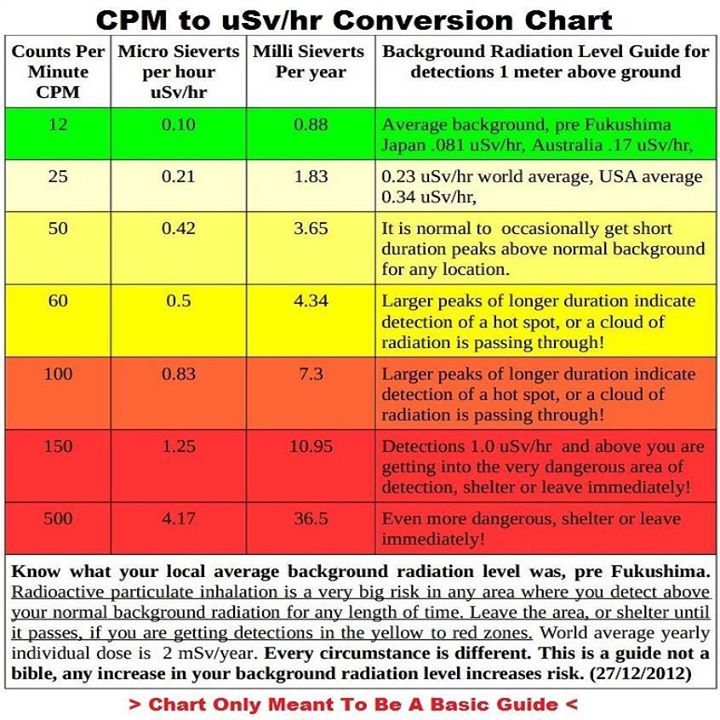


REMEMBER THE READINGS/NUMBERS IN THE VIDEO AT THE TOP OF THIS BLOG ENTRY... 160-200+ CPMs.


What Are Counts Per Minute (CPM) in Radioactivity?

When/If you get a Geiger counter , you’ll need to know about CPM, which is the counts per minute that you’ll see displayed on the analog meter in addition to the corresponding level of radiation.

Once you get your CPM reading from your device, you then need to figure out what that reading means.
What are normal radiation levels CPM and what are dangerous ones?

If you have your Geiger counter calibrated to Cs137, which most are, 1 milliRad per hour would equate to 1,200 CPM on your counter.

At the same time, 1 microSievert per hour would equate to 120 CPM on the reading. These are more universal units of measurement that can help you better understand your radiation exposure.

A CPM reading of at least 100 is considered a warning level by the Radiation Network, although the length of time you’re exposed to the radiation is an important factor.

If you’re concerned about staying within safe radiation levels, it would take 432 days at a CPM of 100 to up your chance of getting cancer to odds of 1 in 1,000.

At higher exposure rates, it would take less time.

For instance, it would only take four days to increase your rate to those odds if you’re exposed to a level of 10,000 CPMs PER DAY.

KEEP THOSE NUMBERS IN MIND, PLEASE.


Radiation Units


Radiation units are confusing. If you remember just one thing, remember that the "badness" in an area can be expressed as micro-Sieverts/hour (uSv/hr) -- i.e., how much "badness" per hour people in that area are getting.

It's cumulative, so if a person is in a 2 uSv/hr area for 6 hours, that's a 12 uSv dose they've accumulated.

Generally a person gets around 4 milli-Sieverts per year from natural sources (i.e. 4,000 uSv).
HOWEVER, the EPA limit for the general public for exposure per year ABOVE background level is "JUST" 1 milli-Sievert per year.

A 100 milli-Sievert dose (i.e. 100 x the EPA limit) is associated with a measurable increase in cancer.


A chest CT scan is about 7 milli-Sieverts of exposure.
ON THAT WEBSITE, NOTE THE FOLLOWING STATEMENT:


"Some scientists believe that low doses of radiation do not increase the risk of developing cancer at all, but this is a minority view."

THE ATOMIC ENERGY COMMISSION STATED DECADES AGO, AND THIS HAS NOT CHANGED, THAT THERE IS NO SUCH THING AS A HARMLESS DOSE OF RADIATION.

THE FDA ALSO HAS A SHORT SUMMARY PAGE THEY TITLED
"RADIATION PROTECTION TERMINOLOGY", BUT IT DOESN'T EXPLAIN MUCH.
MUST NOT PANIC THE SHEEP, RIGHT?
DO NOTICE THIS STATEMENT, THOUGH:

"Gamma rays are similar to X-rays, but are usually more energetic. It travels at the speed of light and is the most penetrating type of radiation. "

In the US, a radiation worker is permitted to get 50 milli-Sieverts per year of exposure. So we're ased to swallow hard and accept that exposure up to 1 milli-Sievert is quite safe, and up to 10 or 20 is "nothing to worry about" (lots of people get CT scans for example).

See the Free Radiation Unit Chart from XKCD


A BIG THANK YOU TO 'MAJIA'S BLOG' FOR THE FOLLOWING:


Converting CPM to MicroSieverts
"There is no direct equation because beta CPM (counts per minute) is an electron count and (micro and milli) sieverts is an account of bodily damage.


Still, in the post below I site an EPA guideline dictating an intervention level at 300 CPM or 10 microsieverts an hour


So, let us for a moment presume that the two are roughly equivalent in a hypothetical scenario that allows us to speculate on the health implications of our current levels of exposure.

If that were the case, exposure to 700 CPM would be roughly 23 microsieverts an hour. That would mean that we in Phoenix yesterday would have hypothetically received 552 microsieverts in a 24 hour period.

In 18 days at 700 CPM we would be at approximately 10 millisieverts of exposure (there are 1000 microsieverts in 1 millisievert) just from exposure to air alone.

We also are exposed to radiation from the machines in our environment, radon gas, food, etc.

These numbers are not looking good.

The EPA recommends that our exposure to background radiation should not exceed 100 millirem a year, which is 1 millisievert, although we ordinarily are exposed to about 300 millirem in the US from background (3 millisieverts). Considerable background radiation derives from nuclear power plants, past nuclear weapons testing and radon gas.

There is no "immediate" health risk from 18 days of exposure of 700 CPM in the sense that people not will develop radiation sickness at this level. However, cancer rates and other diseases have been proven to increase at every 3 millisievert increment over 10 millisieverts."               

BE AWARE THAT MANY ARE "DEBUNKING" THE FOLLOWING READINGS FROM ACROSS THE U.S., STATING THAT THE EPA DOESN'T USE 'NORMAL' GEIGER COUNTERS.

FROM POPULAR MECHANICS, A GOVERNMENT-INFLUENCED CALMING MOUTHPIECE ("Don't worry, be happy!" is what they do best.) , WHICH ACTUALLY ADMITS THAT, "Japanese officials are surveying people leaving the affected areas, and anyone with more than 100,000 cpm of contamination is asked to change clothes (which removes up to 90 percent of the contamination) and possibly to shower."

ABOVE 100,000 CPMs?
HOW ABOUT A MILLION CPMs, 10 MILLION?

THEY NEGLECT TO TELL US WHAT WE SHOULD DO WHEN RADIATION SURROUNDS US EVERY HOUR OF EVERY DAY.
FROM THIS PAST WEEK, THE READINGS, "A LA EPA":  


***HERE ARE LAST WEEK'S CPM READINGS.***
YOU DECIDE IF THIS SHOULD BE OF CONCERN TO US.


Published May 5, 2018
Gamma and Beta CPM by City and State in the US
YTD GAMMA RAD 4/28/20182018 YTD BETA CPMDATECITYST.2010 Census Target Population
YTD GAMMA RAD 4/28/2018
2018 YTD BETA CPM
DATE
CITY
ST.
2010 Census Target Population
3,394,520

4/28/2018
MaxNormalSafeLevel
US

27,314,896Withheld4/28/2018Colorado Springs,CO.645,613
24,246,108Withheld4/28/2018Little Rock,AR.699,757
24,199,642Withheld4/28/2018Raleigh,NC.1,130,490
22,699,778Withheld4/28/2018Portland,ME.514,098
22,445,047Withheld4/28/2018Navajo Lake,NM.Transient
21,279,986Withheld4/28/2018Spokane,WA.527,753
20,219,005Withheld4/28/2018Fresno,CA.930,450
20,068,236Withheld4/28/2018St. George,UT.138,115
19,618,543Withheld4/28/2018Riverside,CA.4,224,851
19,437,835Withheld4/28/2018San Diego,CA.3,095,313
19,201,280Withheld4/28/2018Atlanta,GA.5,286,728
19,014,184Withheld4/28/2018Worcester,MA.916,980
18,828,649Withheld4/28/2018Denver,CO.2,543,482
18,230,282Withheld4/28/2018Tucson,AZ.980,263
18,204,494Withheld4/28/2018Los Angeles,CA.12,828,837
18,069,619Withheld4/28/2018Phoenix,AZ.4,192,887
17,629,266Withheld4/28/2018Idaho Falls,ID.133,265
17,454,461Withheld4/28/2018Grand Junction,CO.146,723
17,375,606Withheld4/28/2018San Bernardino,CA.4,224,851
16,701,423Withheld4/28/2018Boston,MA.4,552,402
16,648,546Withheld4/28/2018Casper,WY.75,450
16,607,028Withheld4/28/2018Yuma,AZ.195,751
16,576,586Withheld4/28/2018Concord,NH.146,445
16,446,672Withheld4/28/2018Bakersfield,CA.839,631
16,384,602Withheld4/28/2018El Paso,TX.622,263
16,003,798Withheld4/28/2018Oklahoma City,OK.1,252,987

..........


SHOULD THE ABOVE IMAGES GO MISSING, THERE IS ALSO A VIMEO VIDEO OF THE ABOVE AT <THIS SITE>.

MR. BOB NICHOLS' INFORMATION FOR THIS WEEK MAY BE FOUND AT

https://www.veteranstoday.com/2018/05/05/million-a-week-club-yrtw-16/


PBS ALSO HAS A RADIATION DOSE CHART <HERE>.

CONSIDER THIS:

"Dose limits alone are not enough to ensure adequate protection. They function in combination with the fundamental principles of justification and optimization.

These limits apply only to doses received above the normal local natural background radiation.

Limits on effective dose, combined with optimization of protection, are designed to avoid a risk of stochatic effects that would be considered intolerable in a planned exposure situation.

Limits on equivalent dose to an organ, combined with optimization of protection, are designed to prevent the occurrence of deterministic effects.

Dose limits apply ONLY in planned exposure situations.
In other situations, restrictions on individual dose are called reference levels. They provide the additional flexibility needed in emergency and existing exposure situations to make sure protection is optimized.

Dose limits do not apply to medical exposures. If they did, the effectiveness of diagnosis or treatment might be reduced, doing more harm than good for the patient. The emphasis is on justification of medical procedures and optimization of protection."


ALSO CONSIDER THIS:

How Much Radiation Is Dangerous?

It depends on whom you ask. Some people will say no amount is safe, but that doesn’t really help us understand the relative dangers. Here are some basic numbers to use as a guide (μSv means microSieverts):


10 μSv – The average radiation you received today

40 μSv – The radiation you receive by taking a flight from New York to L.A.

100 μSv – The radiation you receive during a dental x-ray

800 μSv – Total radiation dose at Three-Mile Island for the duration of the accident

3,000 μSv – Radiation dose from a mammogram

3,600 μSv – Average radiation a US citizen receives in a year from all sources

50,000 μSv –
Maximum allowable yearly occupational dose (USA)

100,000 μSv – Lowest yearly dose likely linked to increased cancer risk

2,000,000 μSv – Severe radiation poisoning (sometimes fatal)


One sievert is 1,000 millisieverts (mSv). One millisievert is 1,000 microsieverts.
SO THE RECENT READING OF 530 SIEVERTS AT ONE REACTOR IN JAPAN,
530 SIEVERTS, NOT MICROSIEVERTS, SIEVERTS per hour, and could be as high as 690 sieverts per hour, MEANS THAT IT WAS EMITTING AT LEAST 530,000.000 MICROSIEVERTS PER HOUR.


AND TEPCO ADMITTED THEY "FORGOT" TO TAKE THE COVER OFF THE MEASURING DEVICE!
THEY JUST ADMITTED THE SAME 'ERROR' 2 DAYS AGO WHEN ANOTHER HIGH READING WAS TAKEN INSIDE THE GROUNDS OF THE PLANT.

"Richard Black, director of the Energy and Climate Intelligence Unit, says that while the readings are not reliable, they still “demonstrate that, seven years after the disaster, cleaning up the Fukushima site remains a massive challenge — and one that we’re going to be reading about for decades, never mind years.”

Mycle Schneider, independent energy consultant and lead author of the World Nuclear Industry Status Report, criticized Tepco, saying the power company has “no clue” what it is doing.

“I find it symptomatic of the past seven years, in that they don’t know what they’re doing, Tepco, these energy companies, haven’t a clue what they’re doing, so to me it’s been going wrong from the beginning. It’s a disaster of unseen proportions.”

In observing the poor maintenance of plant radiation leaks, Schneider also pointed out that the company stores nuclear waste at the site in an inappropriate way.

“This is an area of the planet that gets hit by tornadoes and all kinds of heavy weather patterns, which is a problem. When you have waste stored above ground in inappropriate ways, it can get washed out and you can get contamination all over the place.”


CHERNOBYL TOPPED OUT AT 300 SIEVERTS PER HOUR, IS READING 34 SIEVERTS TODAY.
FUKUSHIMA'S DAIICHI PLANT HAS AT LEAST TWO OTHER HEAVILY LEAKING REACTORS. 
DO THE MATH...

The level of radiation detected at the Fukushima plant immediately after the third explosion in 2011 was 400,000 μSv/h–a level that would be extraordinarily dangerous for humans.
By comparison, that level of radiation is 33,000 times higher than recorded about 750 yards from the containment facility at reactor 4 in Chernobyl.


Here’s the data from Fukushima in 2011:
"Live: 196 locations by crowd-sourced Geiger counters


Futaba, Fukushima, Japan

Median reading in this area is approximately328.000 µSv per hour ( 2873280.000 µSv per year ).


4049.38272 times the average public space Geiger counter reading for Japan (0.081 µSv per hour)*
328.000% the radiation dose you would receive from a chest x-ray (100 µSv)*


Current reading: 328.000 µSv per hour Time: 2011-07-14 13:06:3 "

DOES ANYONE ELSE GET SICK OF HEARING ONLY ABOUT CESIUM, AND SOMETIMES TRITIUM AND STRONTIUM FROM FUKUSHIMA?
THERE ARE A LOT MORE RADIOACTIVE ISOTOPES TO BE CONCERNED ABOUT THAN THOSE TWO.

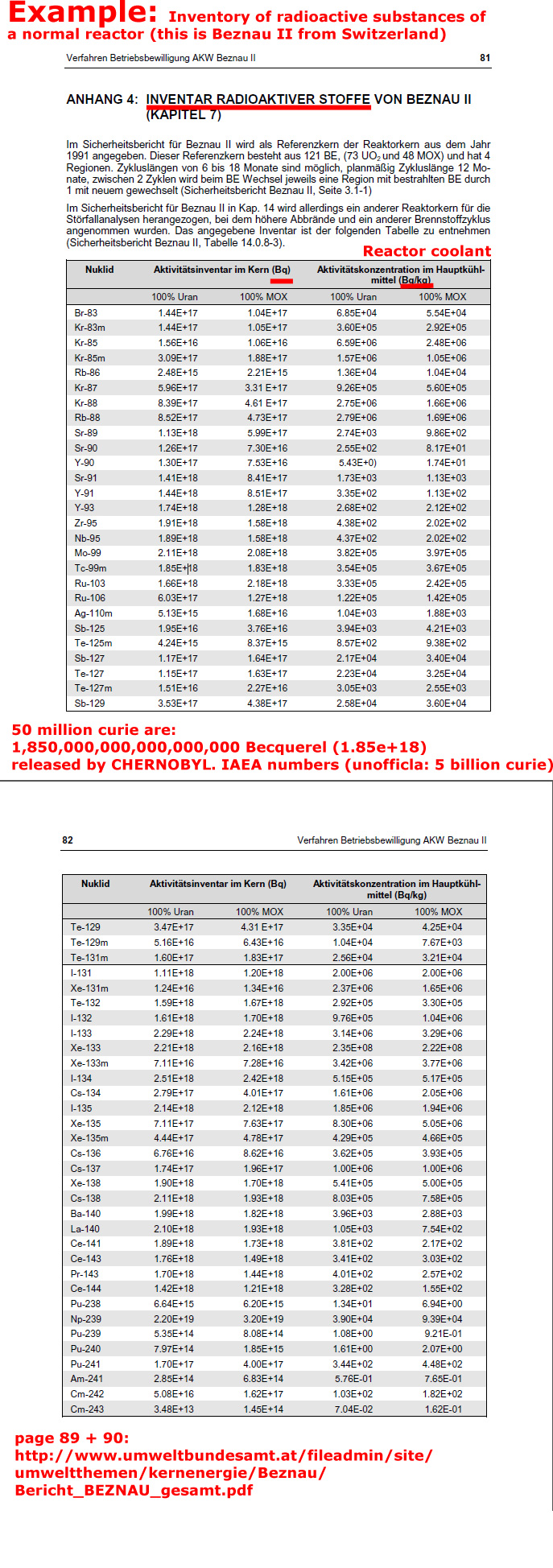
THIS is full list of MAN MADE radionuclides:
http://www.life-upgrade.com/DATA/inventory-reactor-beznau2.jpg


Trillions and trillions of Becquerels are emanating from only ONE reactor at Fukushima today.

"At a ratio of 1:1, Plutonium-239 releases are also 7.6 x 10^13, or 76 tera(trillion)becquerels.
23,000 higher than previous gov’t estimate. 
[…] According to the June 6 estimate by the NISA [see chart below]: Plutonium-239: 3.2×10^9 [3.2 billion becquerels] […]
The amount of plutonium-239 has increased 23,000-fold. […]

Fukushima I Nuke Plant: 154 Terabecquerels Per Day, Every Day of radioactive iodine and cesium still spewing out of the plant, Japan’s Nuclear Safety Commission now admits.
[…] From Yomiuri Shimbun (9:15PM JST 4/23/2011)

"The Nuclear Safety Commission under the Prime Minister’s Office disclosed on April 23 that the amount of radioactive materials being released from the TEPCO Fukushima I Nuclear Power Plant was 154 terabecquerels per day (1 tera is 1 trillion) as late as April 5 when the amount being released was considered stabilized.
On April 5, the estimated amount of radioactive materials released from Fukushima I Nuke Plant was 0.69 terabecquerels/hour for iodine-131 and 0.14 terabecquerels/hour for cesium-137. When the numbers were recalculated according to the INES method (converting cesium amount into iodine equivalent), the amount released turned out to be 6.4 terabecquerels/hour (which was 154 terabecquerels per day. Previously, the Nuclear Safety Commission had simply added the numbers for iodine-131 and cesium-137, and announced it was less than 1 terrabecquerel per hou."

WHAT WOULD BE THE TOTAL IF TEPCO/THE ABE REGIME HONESTLY REPORTED ON ALL REACTORS, ALL HOLDING TANKS, ALL WATER BEING DUMPED INTO THE PACIFIC ALL DAY, EVERY DAY, ALL THOSE MILLIONS OF BAGS OF CONTAMINATED SOIL AND UNDERBRUSH, ETC, SCATTERED ACROSS JAPAN, AND ALL THE INCINERATORS BURNING RADIOACTIVE WASTE EVERY SINGLE DAY?

LIES THE MEDIA AND BIG NUKE'S "EXPERTS" TELL US...

1- SOME RADIATION IS SAFE AND MAY EVEN BE 'GOOD FOR YOU'.
THAT'S A LIE.

2- CHERNOBYL WAS WORSE THAN FUKUSHIMA.
THAT IS A BIGGER LIE.  


In 1970 it was proven that a human fetus is 500 times more vulnerable to radiation than anyone else. And in 1978 this was released in the bulletin of atomic scientists:

"CANCER AND LOW-LEVEL IONIZING RADIATION"
THERE IS NO SAFE LEVEL OF RADIATION.


ICRP, 
 International Commission on Radiological Protection , which is very PRO-Nuke, confirmed in 1966 that natural radiation is harmful.
ICRP Publication Number 8 from 1966 on page 60: "... in relation to the health damage caused by natural radiation for the bulk of the world’s population is a risk of sixth order (1 to 10 dead per million per rad / gray); in a few areas with high natural background radiation the risk fifth order. 10 to 100 dead per million and rad (gray). and in 1977 the ICRP publication number 26 said, that, in this sense, regional differences of the natural radiation are so regarded, that the corresponding differences include the damage. and in the ’80s the natural radiation was simply doubled. and in 2011 it became the twentyfold in japan: 20 mSv/a. Natural radiation is used as an excuse to increase artificial radiation with radionuclides from reactors.

They call that radiation-protection?

       
Prof. Ernest Sternglass and his studies about infant mortality near reactors showed how little it takes to damage a human fetus/babies;: http://www.ratical.org/radiation/inetSeries/ejs1192.html


"JUST" 17 milliSieverts per year means:
16,000 – 32,000 additional cancer deaths AND 150,000 – 1,5 million deaths by genetic diseases:
by John W. Gofman (one of the original scientists who gave us nuclear bombs) , Ph.D., M.D and Arthur R. Tamplin, Ph.D. quote:

“If we use the most optimistic Russell mouse genetic data, and even if we give full credit for slow delivery of radiation, we reach the conclusion that 100,000 extra genetic deaths per year would occur for the allowable average exposure of 170 millirads to the population. This can hardly be construed as an “optimistic” outlook, or a “safe” dose of radiation.”

Professor Yuri Bandazhevsky, a pathologist, Rector of the Medical Institute of Gomel, on the ingestion of radio caesium includes – he said: “Clinical checks on children between 1996 and 1999 show that at levels greater than 50Bq/kg there are pathological changes in vital organs and systems – cardiovascular, nervous, endocrine, immune, reproductive, digestive excretory and eyes. Caesium concentrations in the placenta reveal a relationship with nervous system defects in the foetus. The health condition of the population is a disaster but being a physician myself I cannot accept it as hopeless. With all my faith in God and life I appeal to anyone who can influence it: do your best to improve the situation. There is nothing more precious on this planet than life. And we should do everything possible to protect it.”
See: http://www.spokesmanbooks.com/Spokesman/PDF/91Gifford.pdf


Clause 12 of the Executive conclusion of the Recommendation of the European Committee for radiation risks declares: “…Total maximal permitted dose from all human-caused sources should not exceed 0.1 mSv for population and 5 mSv for personnel”.

This publication is declared by the European Committee for radiation risks as “regulating”. It is only common sense that we should follow the recommendations given in this publication by the scientists from Canada, Norway, Great Britain, Denmark, Switzerland, the USA, Ireland, Sweden, Germany, France, India, Belarus, Finland and Russia.
See: page 16
http://independentwho.org/media/Documents_IW/Forum_Radioprotection_English_Abstracts_IW_2012.pdf


“…To provide an adequate safety standard the dose limit of 1 mSv/y have to be reduced to 0.02 mSv/y or 20 µSv/y.”Page 9: http://www.staff.uni-marburg.de/~kunih/all-doc/stoakuni.pdf by Dr. Horst Kuni, Nuclear Medicine, University Professor.


“European Parliament hears criticisms of radiation protection standards, but don’t publish findings” Brussels 1998: page 35 for example: Childhood leukemia caused by normal reactor operation: http://www.llrc.org/health/subtopic/stoaabstracts.pdf


DOSE AND DOSE RATE , from Geiger Counter Bulletin

There is a lot of confusion going on these days about Dose and Dose Rate. Japan data are generally reported in mSv/hr (milliSieverts per hour) or just plain mSv. When data is properly communicated mSv/hr indicates rate. It’s like driving a car at 50 kilometers per hour. In an hour you will have driven 50 kilometers. If you are exposed to 1 mSv (one milliSievert) per hour for one hour, you will get a dose of 1 mSv.

The amount of radioactivity in a given volume of air, water or tissue is generally expressed in becquerels (Bq). One becquerel means one disintegration (radiation event) takes place every second. So when you hear a sample of water contains 10,000 becquerel of a certain isotope per cubic centimeter it means every second 10,000 radioactive events are happening in that sample.

When translating from Bq to dose or dose rate, it is important to understand the capabilities of the detector and the characteristics of the radiation. Alpha radiation is considered to be 20 times more harmful than beta, gamma, x radiation. It is also not detected by many instruments. The same holds true for beta and neutron radiation. So dose and dose rate can be under-reported if the capabilities of the instrument are not understood. In an emergency situation, confusion and danger can often lead to misinterpretation, or improper reporting of data. It is important to know how to ask the right questions about the data.

Here’s a quick guide to understanding the terminology:

Activity (quantity)
is measured in Becquerel (Curies in the U.S.)

Absorbed Dose is measured in gray (Gy) (Rads in the U.S.)

Dose Equivalent is measured in sievert (Sv) (Rem in the U.S.)

Converting between Conventional Units (used in U.S.) and SI Units (used in Japan and Europe)

To convert millirems (mrem) to microsieverts (uSv) multiply by 10.

To convert microsieverts to millirem multiply by 0.1

Caution: Geiger Counters that are energy compensated do not detect alpha and beta radiation, so any dose rate or dose information will not include alpha or beta dose (only energetic gamma).

Geiger Counters with mica windows will detect alpha and beta, but calibration accuracy in mR/hr or uSv/hr will be affected by the mix of radioactive materials present.  


Scientists: Far more cesium released than previously believed
Source: Asahi AJW
Author: By AKIKO OKAZAKI / Staff Writer
Date: February 29, 2012


"A mind-boggling 40,000 trillion becquerels of radioactive cesium, or twice the amount previously thought, may have spewed from the crippled Fukushima No. 1 nuclear power plant after the March 11 disaster, scientists say.

Michio Aoyama, a senior researcher at the Meteorological Research Institute, released the finding at a scientific symposium in Tsukuba, Ibaraki Prefecture, on Feb. 28.

The figure... is twice as large as previous estimates by research institutions both in Japan and overseas. […] While the latest study said 15-20 quadrillion becquerels of cesium-137 was released into the atmosphere, the Japan Atomic Energy Agency [under-] estimated the amount at 8.8 quadrillion becquerels."   

AS I SAID, WE EACH WILL DECIDE HOW MUCH RADIATION IS ACCEPTABLE TO US, AND WE'LL ALSO DECIDE IF READINGS 7, 8, 10 TIMES BACKGROUND RADIATION POSE NO THREAT OR POSE TOO GREAT A THREAT..

WHAT IS CERTAIN IS THAT FUKUSHIMA RADIATION IS WITH US FOR AT LEAST 100 MORE YEARS, AND SOME OF THE FALLOUT WILL REMAIN TO PLAGUE US FOR MANY THOUSANDS OF YEARS.


FOR ME, FOR THOSE I LOVE, A READING OF 0.0000000000000001  MICROSIEVERTS PER YEAR IS TOO MUCH.

AND A READING OF OVER 10 MILLION CPMs SIGNIFIES AN ACT OF WAR.
BEFORE 2011, BEFORE THE DISASTER IN JAPAN, WE DID NOT SEE READINGS THAT HIGH HERE.

BEFORE WE BEGAN TO CREATE THE NUCLEAR BOMB AND WITH IT, NUCLEAR ENERGY/POWER PLANTS, WE DID NOT SEE THE HIGH NUMBERS OF BIRTH DEFECTS AND CANCERS WE SEE TODAY.


________________________________


ADDENDUM:
FUKUSHIMA IS WORSE THAN CHERNOBYL.   
Counterpunch 27th April 2018:
"
The radiation dispersed into the environment by the three reactor meltdowns at Fukushima-Daiichi in Japan has exceeded that of the April 26, 1986
Chernobyl catastrophe, so we may stop calling it the “second worst”
nuclear power disaster in history. Total atmospheric releases from
Fukushima are estimated to be between 5.6 and 8.1 times that of Chernobyl,
according to the 2013 World Nuclear Industry Status Report. Professor Komei
Hosokawa, who wrote the report’s Fukushima section, told London’s
Channel 4 News then, “Almost every day new things happen, and there is no
sign that they will control the situation in the next few months or years.”

https://www.counterpunch.org/2018/04/27/move-over-chernobyl-fukushima-is-now-officially-the-worst-nuclear-power-disaster-in-history/


BELOW IS JUST ONE SMALL AREA OF JAPAN WITH MILLIONS OF BAGS OF CONTAMINATED SOIL, BAGS THAT ARE CURRENTLY BREAKING APART, BAGS THAT DON'T CONTAIN THE RADIATION WITHIN.


//WW

Friday, April 20, 2018

JAPAN'S UNDERGROUND NUCLEAR LABS: WHY 100,000 EVACUEES WON'T GO HOME?

1994, THE SUNDAY TIMES (UK) wrote that, for the creation of a warhead, Japan has now only to insert the plutonium filling in the device, which is practically ready. There is as yet, the authors of the report emphasize, no evidence that Tokyo has already made the decision to create a "big bomb" or is in violation of the Nuclear Nonproliferation Treaty. But the potential threat of such a step is growing inasmuch as Japan is extremely worried by the efforts of neighboring North Korea to create its own nuclear potential and will, possibly, be confronted with the need to adopt retaliatory measures of a military nature.
All too much indicates that the "peaceful people" from Japan are, according to a plan or with general tacit consent, building on its relief tracks a perfectly usable nuclear armored train."


WHERE ARE ALL THE PLUTONIUM LEAKS COMING FROM?
W
eapons-grade Plutonium leaks in Japan.
The TEPCO Fukushima No.1 nuclear plant's reactors were not the only sources of radioactivity releases.


ABOVE, EVACUATION ZONE, FUKUSHIMA AREA.

JAPAN'S PEOPLE STILL ASK FOR INTERNATIONAL HELP.


THE PLEDGE;  Mr Koichi Oyama 大山弘一  移動パソコン用
[Translation by Dissensus Japan]

"I want to shout for all the people in this world:
“Please Please HELP US!”
We are all manipulated by the words “radiation” and “radiation dose” without knowing the real identity of radiation source.
We are not told the real facts of being irradiated and they force us to believe that it’s just pure metal and they let us believe in “behavior and extra corporeal elimination” and force us to believe in the myth of security.
On top of all that, they only compare radiation dose and natural potassium contained in bananas and manipulated people as if it was a scientific study.

They are always avoiding the issue.
The issue is hold in the hands of enemies and when people know the issue, the energy makes a conciliatory move and took them to neutralize the attack of public opinions.
The guilt of global fallout is the corruption of concession groups of the nuclear industry and medical and insurance companies.

They made cancer to increase in a dramatic way and Japan as a nation that was victim of atomic bombs in the world which have medical history of contamination but they don’t let us know the substances of death ash in Hiroshima and Nagasaki.

And there’s more. They were manipulating us from the beginning of the accident by telling us that “95% of the contamination comes from food, 4% from water, only 1 % from aspiration”.
An adult person aspirates 20m3 of air per day and in weight it’s 20kg.
We take food and water much less than that.

The lung takes varied chemical substances as it takes oxygen from air.
The hot particle size is all 1μm.
It’s really small so it goes into the blood and into the body. Then the organs take them .
The size of mesh hole of the filter to incinerate debris is also 1μm.

The information say that hot particles were diffused and flied [sic] in all directions in Japan.
The particles from hell is flying in the air and people don’t protect themselves anymore three years after the nuclear accident and children are aspirating those horrible particles everyday!!!"
Propaganda videos showing the remarkable recovery of Fukushima have been spread by the government on its social media accounts.


PLEASE PLEASE PLEASE HELP US!

Please let all people in the world to know the life we are living since the accident, everyday and today.
Spreading the radioactive debris and decontamination that doesn’t work is only increasing the number of HIBAKUSHA without good reason.
” 
--Koichi Oyama 大山弘

His blog in the original Japanese can be found <HERE>.  


April, 19, 2018  
World News: Japan ‘covering up Fukushima nuclear danger-zone radiation levels and blackmailing evacuees to return to radiated areas swarming with radioactive pigs and monkeys, many born with severe birth defects LIKE SMALL HEADS. 

[MY NOTE:I waited for our MSM to jump on that 'small heads' term and scream, "ZIKA! ZIKA VIRUS!" since the CDC tried to convince Brazilian mothers in highly radioactive areas that Zika, not radiation, was responsible for the same birth defect in their infants.]

Evacuees accuse the Japanese authorities of wanting to allay public fears over the nuclear power by downplaying the dire consequences of the leak.

Senior nuclear specialist Shaun Burnie, from Greenpeace Japan, said the nuclear nightmare continues.  “They are not telling the whole truth either to the 127 million people of Japan or to the rest of the world – about the radiation risks in the most contaminated areas of Fukushima.

The nuclear crisis is not over – we are only in year seven of an accident that will continue to threaten public health, and the environment, for decades and well into the next century.
Attempts by the government and the nuclear industry [to] communicate that it is safe and it’s over are a deliberate deception.

Burnie continued: “If they can create the illusion of the region that has recovered from the nuclear accident, they think it will reduce public opposition. [to development of nuclear power].  
The massive Ice Wall built at the nuclear plant to stop contamination of groundwater is a symbol of this failure and deception – this is no Game of Thrones fantasy but the reality of a nuclear disaster that knows no end.”

Today he says there were areas of Fukushima where radiation levels could give a person’s maximum annual recommended dose within a week.
"The nuclear crisis is NOT over at the Fukushima plant. €“ We are only in year seven of an accident that will continue to threaten public health, and the environment, for decades and well into next century."

Mr Burnie said the government claims decontamination has been completed in 100 percent of affected areas after a £8bn clean up operation.
But he added: “What they don’t explain is that 70-80 percent of areas such as Namie and Iitate - two of the most contaminated districts - are forested mountain which it is impossible to decontaminate.
“In areas opened in March 2017 for people to return – radiation levels will pose a risk until the middle of the century.
“These areas are still to high in radiation for people to return safely – and is one reason so few people are returning.”

Dr Keith Baverstock, a radiation health expert who was at the World Health Organization at the time of the disaster, told Sun Online: “For the past two years the Japanese government has encouraged the evacuees to return to their homes, but relatively few people have taken up this offer, even though there is a threat – it may even now be a fact – that their compensation will cease.”

Dr Baverstok says the plant and the areas remain a danger zone for humans.
He said: “It seems there is no end in sight for the release of radioactive water from the site and these releases will inevitably put more radioactivity into the food chain if the local waters are fished." 

Most of Japan’s power plants shut in the wake of the Fukushima nuclear disaster.
But in 2015 the Prime Minister announced plans to restart reactors because the economy needed cheap energy and using fossil fuels risked huge carbon emission fines.

WHAT OUR MAINSTREAM MEDIA (MSM) JUST DOESN'T TALK ABOUT IS JAPAN'S NUCLEAR TEST LABS, SET UP ORIGINALLY IN 1941 TO CREATE AN ATOM BOMB FOR JAPAN AND BOMBED DURING WORLD WAR 2 BY 'ALLIED FORCES'.
Japan's leading physicist, Yoshio Nishina, who had worked on the possibility of an atomic bomb with Niels Bohr in Copenhagen,established that first nuke lab outside Tokyo.
Japan's navy ran 2 labs of their own at the same time, but couldn't manage to get enough uranium ore to make the bomb and allegedly closed in 1943.
Nishina's cyclotron was destroyed by bombs dropped on Tokyo on April 13, 1945.

[Source: Future War and Counterproliferation: U.S. Military Responses to NBC Proliferation Threats, Barry R. Schneider, Greenwood Publishing Group, 1999, page 150.]


ON JUNE 8, 2017, THERE WAS THIS REPORT FROM JAPAN, NOT MENTIONED IN OUR MSM: 
TOKYO
-- Five workers at a state-run nuclear research facility near Tokyo have been exposed to dangerous levels of radioactive material, raising allegations of poor management and safety compliance. 
The exposure occurred Tuesday at the Japan Atomic Energy Agency's Oarai Research & Development Center.

Up to 22,000 becquerels of plutonium 239 was detected in the lungs of one man in his 50s, alongside other isotopes. Americium was detected in the lungs of three others. The fifth worker is thought highly likely to have suffered internal exposure as well. The most heavily affected worker faces radiation exposure of 1.2 sieverts over the course of a year and 12 Sv over 50 years. The legal limit for workers handling radioactive material is 0.1 Sv over five years.

"I have never heard of a case of internal exposure this severe," Shunichi Tanaka, chairman of Japan's Nuclear Regulation Authority, said at a news conference Thursday.

The agency's insufficient attention to safety "doesn't seem to be getting much better," Tanaka said.

The JAEA operates more than 10 research facilities around Japan. Each of them is organized differently, and operates under different safety procedures based on the type of research being done. This makes regulating these laboratories a good deal more difficult than overseeing commercial nuclear operations, which use only two types of power-generating reactor.

[NOTICE THIS WAS A VERY, VERY UNCOMMON AMOUNT OF PLUTONIUM IN A WORKER.]

ABOUT THOSE LABS...

The Oarai Research and Development Center of JAEA [JAPAN ATOMIC ENERGY AGENCY] has a long history and tradition of nuclear energy research for nearly half a century, since it was established in the city of Oarai in 1967. 
The Center, having the three research reactors and the related research facilities, provides a unique research complex for advanced
nuclear system development and application, and an open research environment that attracts domestic and international researchers and engineers.
[ONE of the six principal research and development (R&D) Sectors of JAEA.] 

AND THEN, THERE ARE LITTLE 'REVELATIONS', LIKE THIS FROM L.A. TIMES:


New evidence of Japan's effort to build atom bomb at the end of WWII
 

Aug 5, 2015 -
A retired professor at the state-run Kyoto University recently discovered a blueprint at the school's former Radioisotope Research lab, Japan's Sankei
newspaper and other local media reported recently.
The notebooks were related to research work by Bunsaku Arakatsu, a professor at the university whom Sankei said was asked by the Japanese navy to develop an atomic bomb during the war.
Also found were drawings of a turbine-based centrifuge apparently to be used for the study of uranium enrichment.

"These drawings are more confirmation of the Japanese atomic bomb effort, something many in Japan do not want to admit," said Robert K. Wilcox, the L.A. based- author of "Japan's Secret War: Japan's Race Against Time to Build Its Own Atomic Bomb."

The Japanese government burned thousands of documents as the war was ending. Researchers believe many documents related to Japan's atomic bomb program were destroyed. U.S. occupation forces confiscated almost anything that remained.

OBVIOUSLY NOT. 

WHAT REMAINED WERE OTHER UNDERGROUND FACILITIES, THE SECRET NUKE LABS WHICH MANY JAPANESE HAD KNOWN EXISTED, KNEW WERE LEAKING, BUT THEY WERE ASSURED, UNTIL 03/11, THAT THERE WAS NO DANGER TO THEIR HEALTH.
FUKUSHIMA PROVED THAT THEY HAD BEEN LIED TO. 
IT WAS A DOUBLE OUTRAGE.


Masa Takeuchi, who had played a central role in researching thermal diffusion under Nishina, said in the 1960s that Japanese researchers had completed a thermal diffusion device that would have allowed extraction of uranium 235 as early as 1944, but U.S. bombings destroyed their secret facilities. 
The other problem was that Japan couldn't get enough uranium to move forward, another researcher, Kunihiko Higoshi of Gakushuin University, said in 2013.


WASN'T THAT PROBLEM RESOLVED WHEN JAPAN OPENED THE FIRST NUCLEAR POWER PLANT?
THE WORLD,
INCLUDING THE USA, IS MOST WILLING TO SELL ANYTHING NEEDED FOR "NUCLEAR ENERGY".

In an article published in October 1946, the Atlanta Constitution cited an unidentified Japanese officer as saying that U.S. air raids on Japan forced the military to move its bomb plant to Japanese-occupied territory in what is now North Korea, delaying Tokyo's bomb development schedule by three months. 

[IS THAT HOW THE CRAZY LEADERS OF NORTH KOREA GOT A HEAD-START ON BUILDING THE BOMB? WHAT JAPAN LEFT BEHIND?] 

When Japan surrendered, the occupying U.S. forces discovered just five cyclotrons,  devices that speed up atoms in order to separate isotopes that can then be used for a bomb.

JAPAN, 1999.

When Japanese technicians sloppily packed too much enriched uranium — another nuclear weapons fuel — into some wide-mouthed buckets at a factory 75 miles northeast of Tokyo in September 1999, it started to fission spontaneously in a classic “criticality” incident.
Two Japanese workers died, neighboring towns were contaminated with radiation, and industries essential to the region’s economy were disrupted. Schools closed, police barricaded roads, and trains stopped running. More than 160 people within a quarter-mile were evacuated, and another 310,000 people living and working nearby were ordered to seek shelter.

There was no explosion, just the usual blue Cherenkov flash, marking the spread of radiation around the Tokaimura plant in a chain reaction that pulsed intermittently for 20 hours.
It exposed 119 people to doses exceeding the 1 millisievert level recognized by the International Commission on Radiological Protection as the maximum that members of the public can safely be exposed to in a year, according to the World Nuclear Association, a nonprofit organization that advocates expanded reliance on nuclear energy. Those contaminated were a mix of plant workers and others who by chance happened to live or work nearby.  

Hisashi Ouchi and Masato Shinohara, who were in the room where the criticality occurred and absorbed extremely high doses — 1,700 and 1,200 rems of radiation, respectively — appeared normal when they entered the University of Tokyo Hospital Emergency Department on the same day. But within weeks, Ouchi became unrecognizable, inside and out.

ABOVE: The devastating effects of the Tokaimura criticality accident on Masato Shinohara, 40, are evident in these hospital photos chronicling his physical decline. He died seven months after the accident.

Slowly, his skin sloughed off and his muscle tissue died. Externally, his body withered into a skeletal silhouette, covered in open sores. Inside his body, his chromosomes shattered like glass. Sequentially, his organs failed.
By the 63rd day of his ordeal, doctors were pumping 10 liters of liquid into Ouchi to replace the fluid he was losing from surface wounds and massive intestinal bleeding.
He died in December, 1999, 83 days after the accident. 

Shinohara’s physical decline wasn’t as meticulously chronicled as Ouchi’s. But the outer layer of his skin molted from 70 percent of his body, and his body shut down in the same sequence that Ouchi’s had.
He lived for 210 days after the accident, until he succumbed to MRS pneumonia on April 27, 2000.  


Underground lab tackles Japan nuclear waste issue - The San Diego Tribune July 14, 2014

IS IT JUST WASTE OR A WEAPONS TEST LAB?


FROM RUSSIA AND THE UK, BUT NOT REPORTED BY MSM HERE:

"Nuclear Armored Train for Japan"
Possibility of Japan's Developing Nuclear Weapons Weighed
by Vasiliy Golovin, Moscow, EKHO PLANETY No 8,
February 1994 (signed to press 16 Feb 94) pp 18-23 

Tokyo--Instructions for official use printed on gray-green wrapping paper almost caught my eye about 15 years ago, when I found myself at routine training courses for officers of the reserve. They were devoted to the military possibilities of the Pacific countries, and the Japanese section of this manual confidently said that Tokyo had all the possibilities for nuclear arms and was prepared to realize its potential in the very near future. It inexorably ensued from the instructions that the perfidious Samurai were dreaming of nothing other than how to get their hands on a nuclear bomb and hurl themselves into new conquests.

It surfaced on 30 January of this year in the respectable London SUNDAY TIMES, which has always been considered a model of journalistic conscientiousness and has never, we are assured, been caught out in major fact-juggling. On this occasion the newspaper reported that Britain's Defence Ministry had in December of last year presented its government with a classified report on Japan having everything necessary for the creation of nuclear weapons. It was a question, you will note, not simply of the general potential, which, essentially, no one denies.

No, the British military, in the paper's words, declared that Tokyo already, in fact, possesses all the practical components of a nuclear weapon, including intricate electronic firing mechanisms, which have been a stumbling block for many "third world" countries attempting to take possession of the cherished bomb.

Essentially, THE SUNDAY TIMES wrote, for the creation of a warhead Japan has now only to insert the plutonium filling in the device, which is practically ready.

There is as yet, the authors of the report emphasize, no evidence that Tokyo has already made the decision to create a "big bomb" or is in violation of the Nuclear Nonproliferation Treaty. But the potential threat of such a step is growing inasmuch as Japan is extremely worried by the efforts of neighboring North Korea to create its own nuclear potential and will, possibly, be confronted with the need to adopt retaliatory measures of a military nature.

The article in the British newspaper caused embarrassment in Tokyo. To my insistent inquiries officials of the Ministry of Foreign Affairs and the Science and Technology Agency, which is in charge of Japan's nuclear programs, initially refused to "confirm or deny" THE SUNDAY TIMES report altogether.
Only a representative of the National Defense Agency categorically termed the British article utter rubbish, but just as emphatically asked me not to mention his name here.

Finally, over 24 hours after the appearance of the publication, a news conference with Kuniko Saito, first deputy minister of foreign affairs of Japan, was organized in Tokyo. The mere fact of it being held, incidentally, was something quite rare for Japan, where employees of the Foreign Ministry have no great liking for openly addressing the public, preferring anonymous briefings for trusted journalists, after which the requisite articles containing references to "high-ranking sources in the Foreign Ministry" opportunely appear.

But on this occasion the country's highest-ranking professional diplomat deemed it necessary to violate this tradition in order to lend special authority to an emphatic refutation of the rumors concerning Tokyo's nuclear plans. Saito emphasized strictly that Japan adheres unswervingly to the three nonnuclear principles proclaimed by its government--not to have, not to manufacture, and not to import nuclear weapons.

He announced simultaneously that the Foreign Ministry intended to contact the British Defence Ministry and clarify with it the question of the existence or otherwise of a classified report.

Few of those present at the news conference noticed, it seems to me, that behind the decisiveness of these words Saito was refuting not entirely what had been stated by the sources in London.
They had not said that Japan was "in violation" of the Nonproliferation Treaty or was "already making" a nuclear bomb. As far, on the other hand, as the highly specific possibilities for its manufacture are concerned, the opinions of the British report and of independent experts working in Tokyo are surprisingly coincident here.

"Is Japan ready to create nuclear weapons? Of course," Haruo Fujii, one of Tokyo's most celebrated military specialists, who regularly presents commentaries in the news media, told me. But, in the expert's opinion, it would be profoundly wrong to suspect Tokyo of the implementation of some secret, mind-boggling program and the creation of secret nuclear laboratories concealed, in the manner of the old inimitable James Bond movies, somewhere in romantic underground bunkers or in the craters of volcanoes.

No, everything is far more prosaic: Japan, the expert believes, cleaves to a long-term strategy of the gradual creation of operational nuclear potential "bit by bit," dispersing this work in discrete civilian sectors evoking no suspicion. The point being that Japan is not, forgive the banality, Iraq. It possesses a colossal, very ramified diversified industry and is engaged in a tremendous number of technological developments in a myriad research institutes, the best of which belong to private companies.

At the same time, on the other hand, as Tetsuo Maeda, a former member of the staff of the National Defense Academy and an independent military expert who is well known here, told me, with the present system of parliamentary approval of the budget, it is practically impossible in the country to conceal some large-scale government spending on research without an indication of its specific purpose.

The general secretary of the Cabinet of Ministers does, it is true, have at his disposal restricted funds not subject to accounting, but I have no information as to whether they are sufficient for funding serious long-term work.
Under these conditions, experts believe, the emphasis has been put on encouraging "just in case," by way of various indirect privileges and legal budget infusions, the development of highly intricate dual-purpose technology which is being undertaken in private companies. This strategy is producing results.

For example, companies of the country long since created unique firing mechanisms for performing complex petroleum-prospecting exploration, which may now be used as detonators for an atomic bomb, the above-mentioned Tetsuo Maeda, whose opinion is shared by Haruo Fujii also, informed me.
These firing mechanisms have been tested and are being employed successfully in oil fields of the Near East. There is reason to believe that it is to these that the authors of the sensational "British report" could have been referring. "

STRAIGHT FROM THE PEOPLE THERE, REVELATIONS OF LEAKING UNDERGROUND NUCLEAR TESTING LABS ALL OVER JAPAN THAT HAVE BEEN THERE FOR DECADES.


Weapons-grade Plutonium leaks in Japan.
Who's making NUKES?
Secret Underground Nuke Labs? 
By Yoichi Shimatsu


[
The author is the former Editor of the Japan Times Weekly. Mr. Yoi is a former Tsinghua University lecturer and is a free lance journalist based in Hong Kong.]

Exclusive to Rense
03-09-18

"
On this 7th anniversary of the Fukushima triple disaster, a video on Japanese N-weapons production in the Greater Fukushima region, produced by French environmental filmmaker Phillippe Carillo and myself, based on the disturbing findings from my dozen research visits into the 20-30 km nuclear exclusion zone is being released here at rense.com. Here the key points are summarized:

First, the meltdowns at three civilian reactors and related fires at the TEPCO Fukushima No.1 nuclear plant were not the only sources of radioactivity releases. As dangerous as it turned out to be, including the explosion of the weapons-related mixed-oxide (MOX) fuel rods inside the Toshiba-Westinghouse Reactor 3, the rate of isotope releases solely from Fukushima plant cannot account for the grandeur of scale of contaminated seawater and marine-layer moisture that’s been hitting the American shores.

Second, a much greater amount of highly enriched plutonium was released from separate nuclear disasters that occurred at four nuclear-warhead production sites:

- an underground lab inside the compound of the seaside Haramachi coal-fired plant operated by the Tohoku Electric Power Company, less than six km north of Fukushima No.1;

- the TEPCO Thermal (oil-fueled) power plant in Hirono, about 4 km south of the Fukushima No.2 nuclear plant in the Iwaki district;

- a yet-uncovered lab or processing center inside the Fukushima No.1 compound; and

- a military nuclear-weapons test site in Kitakami, near its namesake mountain range, in Iwate Prefecture, north of Fukushima and Miyagi prefectures.

In addition, steady releases of heavy water have flowed out of a suspected tritium-extraction facility inside the hollow structure of the Kido Dam, in the hills west of Hirono town. According to local residents, there are several other sensitive sites in the eastern Abukuma Plateau, making the Greater Fukushima nuclear complex one of the largest and the most-advanced warhead production site in the world.

It might be noted here, though unmentioned in the video, that the military-focused nuclear program will soon be resuming at the Oma nuclear plant on the northern tip of Honshu, near the Misawa USAF base and within sight of Hakodate, Hokkaido, across the Tsugaru Strait. The remote area has no major city in the vicinity for the marketing of electricity. One of the ramifications of secret weapons development by Japan is that it compels North Korea to amass a deterrence capability, and unless the Japanese program is officially exposed and dismantled, Northeast Asia will continue to be a center of nuclear-weapons confrontation between at least five countries.

The misdirection of focusing solely on Pyongyang, of course, has not only been hypocritical, it is a massive self-deception concerning Japanese duplicity over its vaunted “Three Non-Nuclear Principles”.

When its warhead-production is fully functioning again it will be merely a matter of time before a revanchist faction decides to get its revenge for Hiroshima and Nagasaki, although in the meanwhile the radioactive outflows from Fukushima are doing that task quite efficiently.

Headquartered in neighboring Miyagi Prefecture the Tohoku Electric Power Company (a regional utility company unrelated to TEPCO) burns North Korean coal at its Haramachi thermal plant. Curiously, none of that enormous power supply is delivered to the nearby city of Soma or to Miyagi communities across the provincial border. All of its 20,000kW output is allocated to the TEPCO Fukushima No.1 nuclear plant or used on-site for indeterminate purposes. Why does a large-scale conventional power plant have to be dedicated to powering a nuclear plant along with its own massive energy consumption?

This question is the key to unlocking the secret vault of nuclear-weapons production. As exposed by my April 2011 interview with a parliamentarian who was trained in nuclear engineering, the earthquake-caused collapse of the power-transmission line from Haramachi resulted in the outage that knocked out the computers controlling the Fukushima No.1 facility, the first falling domino that led to the meltdowns.

Enormous amounts of continuous power are required for the new GE-Hitachi “global laser extraction” system employing gasification, electromagnetic charging and laser-separation of enriched plutonium from spent fuel rods. This novel process defies the traditional view that Pu cannot be separated from the uranium content in mixed-oxide rods, thereby enabling vast arsenals of hydrogen bombs to now be rapidly produced from nuclear waste from civilian power plants. Research and full-on production were being conducted in secret at the three secret underground labs: Haramachi, Hirono and somewhere underground at the Fukushima No.1 site.

To spare itself the burden of an effective containment program, Japan has been waging a “soft” nuclear war against its Pacific neighbors. Over the past seven years, I have suggested that boring tunnels into the hard-rock Abukuma Plateau is a proven method for water storage, as done under Kanto region rivers in lieu of new dams, but the government apparently prefers overseas dumping as a type of passive-aggressive vengeance.

Considering that the corium, or melted fuel rods, is mostly self-contained in the gravel and rock below the destroyed reactors, the math still would not account for the mega-effects of 311 on the environment of the Northern Hemisphere, which includes the sudden expansion of the Arctic ozone hole April-June 2011, fragmentation of the ice cap, annihilation of the wild salmon fisheries, the West Coast drought and lightning-triggered wildfires, poisoning of milk from dairy cows, and other bleak news that’s gone unreported in the mass media or falsely attributed to global warming, al in the service of course of the utilities companies that operate nuclear power plants.

How then did Fukushima disaster manage to achieve such planetary destruction while Japan itself remained relatively unharmed? The underlying answer to this paradox is center of the most pervasive cover-up in scientific history, authorized at the highest levels of the UN nuclear-energy agency IAEA, the U.S. Department of Energy (DOE) and uranium-producer Canada’s Nuclear Safety Commission. After failing to warn, much less protect billions of their residents, the “regulators” in the US and Canada have been complicit in a cover-up of the rising radioactivity risk to population centers in the Americas due to their idolatrous worship of the nuclear bomb, the Moloch of our modern times.

The total absence of health-related data concerning radioactive ingestion, has forestalled any accurate determination of whether a global “hibakusha” (radioactivity victims) crisis is under way, but certainly the unborn have been sacrificed in their millions through miscarriages from radioactive exposure of ovaries and abortions out of unspoken fear. By the time in the future, or perhaps never, when studies are done on the spike in heart failure and cancers on top of terminated pregnancies, it will be too late for the health-care system to launch effective preventative measures to preserve the humane genome. As in the loss of insects across the Americas due to our inaction, homo sapiens will soon be extinct. And perhaps for the better, since our collective inaction proves the streak of inbred criminal denial in our less-than-masterful species.


Deadly Fallout across Minami-Soma, at least 1,000 died.

The Japanese government claimed that the Fukushima nuclear disaster took only a single life, the death of a nuclear worker. This grotesque deception was perpetrated to prevent an international investigation under the nuclear Non-Proliferation Treaty (NPT).

At least 1,000 nuclear-weapons technicians and Self-Defense Force soldiers were killed inside the flooded Haramachi lab with no chance of escape or rescue due to the intense nuclear releases. Outdoors in the surrounding Minami-Soma district, high radioactivity levels forced the pullout of police rescue teams, abandoning many thousands of local villagers to die of a combination of radioactive fallout and freezing temperatures.

A longtime media colleague, photographer Takashi Morizumi was in that district three days into the disaster response and then a month later recounted to me: “Despite the risk to their own lives, those local policemen were begging, some with tears in their eyes, for permission to take on the risks of entering the radioactive circle to save their relatives and friends. Their morale was crushed when their appeal was rejected.”

On the edge the 20-km earliest exclusion zone, several hotspots northwest of the plan were due to nuclear materials that had been swept inland by the tsunami from the Haramachi nuclear-weapons site. In the Japanese language “hara” means a broad plain, and the stream-laced coastal plain lays flat for some distance into the interior between low hills. Due to the powerful seawater pressure, the front wave rose up the valleys (pushed from behind by tsunami force) and deposited the nuclear materials before receding. A local resident, who worked for state-run soil decontamination project, said the inland sites were left for last, being the most dangerous to health.

About 2 months later, a leak from employees at the Fukushima University Medical School Hospital indicated more than a thousand bodies in white lab coats and military uniforms were being kept inside a walk-in freezer in the hospital morgue. The cynical claim that the Fukushima nuclear disaster claimed only one life omits the deaths from the secret nuclear lab at Haramachi.

In the Hirono town region, south of Fukushima No. 2, [was] an evacuee, whose house had collapsed in the 311 quake. When he rested on the stones of a low embankment, he told me: “This place is known as the ‘hot corner’ because the radioactivity has always been high here.”

"Since Fukushima?", I asked.

“It’s been radioactive here for many decades” was his reply. “TEPCO claims this is a conventional plant but in reality nuclear work’s been going on here for decades.”
On another bike journey into the surrounding farmlands, I saw daisies bigger than my two hands put together and gladiolus stems twice my height, indicating genetic mutations causing gigantism over many generations.

Despite a massive security presence around the TEPCO oil-fueled thermal plant, and being berated once and expelled by plainclothesmen with the secret nuclear security force, I managed on several occasions into slip into the J-village soccer stadium site, where the Fukushima workers were housed. To my astonishment, most of the young works coming off-duty told be that their entire workforce was assigned to clearing nuclear waste out of the Hirono thermal plant, which confirmed the first old-timer’s claim that this was a secret nuclear production site, which means of course for N-weaponry. ‘

Indeed, behind a visual barrier of dense groves of fir trees, huge cranes were working night and day, and dump trucks roared out the gates and through the tunnels of Highway 6 to a loading dock, where waste was transferred to rail cars for outdoor storage in four inland prefectures. I could not help but feel alarmed as trucks blew off dust clouds over groups of children returning home from school. The Education Ministry had issued a nationwide order to public schools not to enroll out-of-town children so these kids were trapped on the edge of the exclusion zone. The saddest sight was to see teenage girls who had recently returned from temporary evacuation riding the local trains, with a quiet forlorn look of acceptance of their fate.

A young store clerk in the inland city of Koriyama, who recognized that I was not a government agent, disclosed: “A lot of guys from the coast moved here after the tsunami and rented the biggest apartments. They all drive around in Mercedes. All they do everyday is drink and gamble at cards. We’ve heard that each received 70 million yen ($750,000 at that time’s forex rate) from the government.”

“For what?” I asked.
His answer: “Nobody knows”.
Obviously, the payoffs were part of a sweetheart deal for the nuclear-weapons technicians on condition of their silence. Other than late-coming paltry “compensation” for evacuees from inside the exclusion zone, provincial and regional residents living in radioactive homes where the local economy has been impoverished by the nuclear crisis received not a single aluminum yen and zero tax breaks.

One sunny morning after a chilly night in the “hot” rain, I was investigating how the government was rigging radioactivity detection equipment when a group of grass-cutters approached while clearing the roadsides of radioactive weeds. Needless to say, they were stunned that I had slept outdoors. They warned me to be extremely cautious of the secret nuclear security forces because over past decades many locals who entered the mountainous areas were detained, questioned and ordered never to come back by men in brown uniforms, who were neither with the police nor from the self-defense force.

I took their warning seriously, and on many occasions carried my bicycle and gear up forested hillsides and waited under the eaves of abandoned houses until my pursuers gave up the chase. Then, a few years on, I traveled by car with filmmaker Phillippe Carillo, to a dam suspected of serving as a tritium-production facility. It was up a steep road at the edge of the Abukuma Plateau without human habitation in sight. We were soon joined by a truck, and we were obviously under surveillance. Then cars came roaring up and men in green uniforms ran to the entry doors of two towers on the dam to check if we had broken in. While they were preoccupied doing a full security check on the mystery dam, we tiptoed to the car and drove downhill as fast as possible. This drama was happening in “the middle of nowhere”.

The villagers had not been jesting with me.


The video closes with my bicycle journey in southwest Fukushima Province to an abandoned uranium mine run by Bund-1, a joint atomic bomb project of the Japanese militarist government and Nazi Germany in the late 1930s. A physicist at Fukushima University was the world’s first scientist to theorize the immense power of atom-splitting, and so the seed for the nuclear age was planted here, in this accursed soil.

One of the adverse aspects of the video shooting was the burn-out of so many cameras, Geiger counters and computers due to radioactivity and the consequent necessity for ever-cheaper equipment, in addition to clothing. Unfortunately many photos were blotted out by the passage of gamma rays. For example, a group portrait of mating season for golden beetles. Deep in a forest by a stream, I spotted a circle of these shiny creatures lying dead around a femme fatale.

What happened is that when the males closed in around the fertile female, the increasing radioactivity level from their bodies during the convergence killed all of them. The increase of body radioactivity levels during crowding accounts for the mystery of the sudden deaths of commuters inside the Tokyo metro system in recent years. For a survivor condemned to avoidance, and by now we’re all hibakusha, it is a path of loneliness." 

THERE ARE SEVERAL REVEALING PHOTOS AT THE WEBSITE LINKED ABOVE AND MORE DETAILED DESCRIPTIONS OF THE ACTIVITY AROUND THEM SINCE THE TSUNAMI. 

THIS PARTICULAR TEA ROOM BLOG IS THE RESULT OF AN "ANONYMOUS" COMMENT I HAD TO MODERATE THAT WAS IN RESPONSE TO THE BLOG TITLED "FUKUSHIMA EVACUEES' FORCED RETURN UNDER FIRE AT UN ".

I ALMOST ALWAYS DELETE ANONYMOUS COMMENTS, AS MOST OF YOU KNOW, BUT THIS ONE CAUGHT MY EYE BECAUSE IT BEGAN, "PLEASE DO NOT PUBLISH THIS. THERE IS SOMETHING YOU MUST KNOW..."

IT WAS WHAT FOLLOWED, INSIGHTS INTO RADIOACTIVE LEAKS ALL OVER JAPAN FOR DECADES, AND RESIDENTS WELL AWARE OF UNDERGROUND TEST FACILITIES THAT MAY BE DISGUISED BY THE NUCLEAR POWER PLANTS NEAR THEM.
ONE EXPECTS A CERTAIN AMOUNT OF RADIATION TO BE EMITTED FROM THOSE SITES EVERY DAY, SO WHO WOULD THINK TO QUESTION RADIATION NEAR THOSE PLANTS, RIGHT?
WHAT ABOUT UNDERGROUND LABS NEAR ACTIVE VOLCANOES?
WOULDN'T THE FREQUENT QUAKES ASSOCIATED WITH THOSE ALSO CAMOUFLAGE A SMALL NUCLEAR TEST?
DON'T ALL VOLCANOES EMIT SOME RADIATION AS WELL?

"Naturally occurring thorium, uranium, radon, etc. are all in the material emitted by volcanoes."
BUT NOT PLUTONIUM...

Japan Has Nuclear 'Bomb in the Basement,' and China Isn't Happy
NBC NEWS, March 11, 2014

China’s belief in the “bomb in the basement” is strong enough that it has demanded Japan get rid of its massive stockpile of plutonium and drop plans to open a new breeder reactor this fall.

Japan signed the international Nuclear Non-Proliferation Treaty, which bans it from developing nuclear weapons, more than 40 years ago.

But according to a senior Japanese government official deeply involved in the country’s nuclear energy program, Japan has been able to build nuclear weapons ever since it launched a plutonium breeder reactor and a uranium enrichment plant 30 years ago.

Related Story: Japan Producing Huge Stockpile of Plutonium 


WHAT ELSE IS LEAKING IN JAPAN? 
CERTAINLY NOT TRUTH, EXCEPT FROM SOME OF HER PEOPLE, THOSE BRAVE ENOUGH TO FACE JAIL TO TELL US WHAT THEY KNOW. 

WE SHOULD LISTEN CLOSELY. 

TO THE ANONYMOUS COMMENTER WHO IS RESPONSIBLE FOR THIS BLOG ENTRY, THANK YOU, AND MAY YOU BE ALWAYS WELL.


___________________________

FURTHER READING

1~
Japan Confirms Secret Nuclear Pacts With U.S.

MARCH 11, 2010, EXACTLY ONE YEAR BEFORE THE EARTHQUAKE AND TSUNAMI:

Japan's government said this week that previous administrations had lied to the public for decades about atomic weapons. A government-appointed panel confirmed the existence of secret Cold War-era agreements allowing the U.S. to bring nuclear weapons into the country in violation of Japan's non-nuclear policies.
Foreign Minister Katsuya Okada announced the panel's findings on Tuesday, putting an end to decades of both official denials and public speculation. But while admitting that secret agreements existed, Okada was vague on the question of whether U.S. nuclear-armed vessels entered the country. 
Since taking power last August, the Democratic Party of Japan has begun to overhaul the policies of the Liberal Democratic Party, which dominated Japanese politics after World War II. The investigation into the secret pacts is one of these efforts.

The U.S. stored both tactical and strategic nuclear weapons on the island of Okinawa, which it directly administered until 1972. The weapons were mostly intended for use in the event of conflict with China.

Since 1958, the U.S. has maintained a policy of neither confirming nor denying the location of its nuclear weapons.

The investigation's findings confirm what many Japanese already knew. Takichi Nishiyama, the Mainichi Daily reporter who uncovered one secret pact in 1972, remembers the day he obtained a Foreign Ministry document that proved the existence of a clandestine deal.
"This was clearly a violation of the constitution and a political act that should never have been committed," Nishiyama says. "I was both shocked and angered to see this."

Nishiyama's scoop could have become Japan's Watergate. Instead, Nishiyama was convicted of illegally obtaining the document via his relationship with a female Foreign Ministry secretary. The Japanese media did not pursue the story and Nishiyama was forced to quit his job.

Nishiyama is now 79 and still fighting in court to clear his name.


2~ FUKUSHIMA, USA? IT'S ONLY A MATTER OF TIME.

Repeated safety lapses hobble Los Alamos National Laboratory’s work on the cores of U.S. nuclear warheads By The Center for Public Integrity, Patrick Malone, Jun. 29, 2017

Technicians at the government’s Los Alamos National Laboratory settled on what seemed like a surefire way to win praise from their bosses in August 2011: In a hi-tech testing and manufacturing building pivotal to sustaining America’s nuclear arsenal, they gathered eight rods painstakingly crafted out of plutonium, and positioned them side-by-side on a table to photograph how nice they looked.

At many jobs, this would be innocent bragging. But plutonium is the unstable, radioactive, man-made fuel of a nuclear explosion, and it isn’t amenable to showboating. When too much is put in one place, it becomes “critical” and begins to fission uncontrollably, spontaneously sparking a nuclear chain reaction, which releases energy and generates a deadly burst of radiation. The resulting blue glow — known as Cherenkov radiation — has accidentally and abruptly flashed at least 60 times since the dawn of the nuclear age, signaling an instantaneous nuclear charge and causing a total of 21 agonizing deaths. So keeping bits of plutonium far apart is one of the bedrock rules that those working on the nuclear arsenal are supposed to follow to prevent workplace accidents. It’s Physics 101 for nuclear scientists, but has sometimes been ignored at Los Alamos.

Catastrophe was avoided and no announcement was made at the time about the near-miss — but officials internally described what happened as the most dangerous nuclear-related incident at that facility in years. It then set in motion a calamity of a different sort: Virtually all of the Los Alamos engineers tasked with keeping workers safe from criticality incidents decided to quit, having become frustrated by the sloppy work demonstrated by the 2011 event and what they considered the lab management’s callousness about nuclear risks and its desire to put its own profits above safety.

The exact cost to taxpayers of idling the facility is unclear, but an internal Los Alamos report estimated in 2013 that shutting down the lab where such work is conducted costs the government as much as $1.36 million a day in lost productivity.

And most remarkably, Los Alamos’s managers still have not figured out a way to fully meet the most elemental nuclear safety standards. When the Energy Department on Feb. 1 released its annual report card  [THAT LINK IS TO A PDF] reviewing criticality risks at each of its 24 nuclear sites, ranging from research reactors to weapon labs, Los Alamos singularly did “not meet expectations.”

In fact, Los Alamos violated nuclear industry rules for guarding against a criticality accident three times more often last year than the Energy Department’s 23 other nuclear installations combined, that report said. Because of its shortcomings, federal permission has not been granted for renewed work with plutonium liquids, needed to purify plutonium taken from older warheads for reuse, normally a routine practice.

Moreover, a year-long investigation by the Center makes clear that pushing the rods too closely together in 2011 wasn’t the first time that Los Alamos workers had mishandled plutonium and risked deaths from an inadvertent burst of radiation. Between 2005 and 2016, the lab’s persistent and serious shortcomings in “criticality” safety have been criticized in more than 40 reports by government oversight agencies, teams of nuclear safety experts, and the lab’s own staff.

James McConnell, the top NNSA safety official, said in an interview that “safety is an inherent part of everything we do.” But at a public hearing in Santa Fe on June 7, McConnell was also candid about Los Alamos’s failure to meet federal standards. “They’re not where we need them yet,” he said of the lab and its managers.   

The huge, 39-year-old, two-story, rectangular building at Los Alamos where the 2011 incident occurred is the sole U.S. site that makes plutonium cores — commonly known as pits because they are spherical and placed near the center of nuclear bombs — for the warheads meant to be installed over the next three decades in new U.S. missiles, bombers, and submarines.

Production of these cores is a key part of the country’s effort to modernize its nuclear arsenal at a cost of hundreds of billions of dollars, which President Obama supported and President Trump has said he wants to “greatly strengthen and expand.” Trump’s proposed fiscal year 2017 and 2018 budgets would boost U.S. spending on such work by $1.4 billion, representing a slightly higher percentage increase (11%) than requested overall for the Defense Department.

But mostly because of the Los Alamos lab’s safety deficiencies, it hasn’t produced a usable new warhead core in at least six years. Congress mandated in the 2015 National Defense Authorization Act that Los Alamos must be capable of manufacturing up to 20 war-ready cores a year by 2025, 30 the next year and 80 by 2027. Wolf said the agency remains committed to meeting this goal, but other government officials say the dramatic slowdown at PF-4 has put fulfillment of that timetable in doubt.

PF-4 is also the only place where existing cores removed randomly from the arsenal can be painstakingly tested to see if they remain safe and reliable for use in the nuclear stockpile. That work has also been blocked, due to PF-4’s extended shutdown, according to internal DOE reports. The lab tried to conduct those tests in late 2016, but without success.


There is a timeline on that website that traces the long and troubled history of safety deficiencies at Los Alamos National Laboratory’s Plutonium Facility by detailing the timing of some 40 government reports and expert presentations spanning the past 11 years.

IT'S A TICKING TIME BOMB, JUST LIKE HANFORD, WIPP, SAVANNAH, PILGRIM, TURKEY POINT AND AT LEAST A DOZEN OTHER U.S. NUKE FACILITIES.


JAPAN DOESN'T NEED 'THE BOMB'...SHINZO ABE HAS FUKUSHIMA.

IT'S HIS SINISTER GIFT TO ALL THE WORLD, A GIFT THAT KEEPS ON GIVING.


//WW

Sunday, April 1, 2018

DEADLY CHEMICAL HYDRAZINE ABOARD FALLING SPACE STATION TIANGONG-1


Tiangong-1 is currently predicted by The Aerospace Corporation on 2018 April 1st to reenter the Earth’s atmosphere around April 2nd, 2018 00:30 UTC ± 1.7 hours.


The United States Strategic Command’s Joint Space Operations Center, “provides Trajectory Impact Prediction messages concerning space debris to many locations” informs the FEMA operations centers, “which monitor the data for the FEMA Administrator,” according to FEMA’s National Warning Systems operations manual.

The National Warning System “is a 24-hour continuous private line telephone system used to convey warnings to federal, state, local, tribal, and territorial government and public safety officials,” a FEMA spokesperson told Gizmodo. The organization pays closer attention to nuclear objects or those that may have poisonous fuels.

Once the authorities are notified, they would use the Integrated Public Alert and Warning System to warn people in danger.

Warning the right people could be difficult, though—the projected location is wildly unpredictable.

As the ESA writes in the same FAQ, “Even 7 hours before the actual reentry, the uncertainty on the break-up location is a full orbital revolution—meaning plus or minus thousands of km!”

The strike itself would litter debris spread over an area a hundred miles long and a few miles wide, says Harvard Astrophysicist Jonathan McDowel.  


Launched: 2011 September 30 @ 03:16:03.507 UTC
Site: Jiuquan Satellite Launch Center, China

Mission: Tiangong-1, First Chinese Space Station
Mass: 8500 kg at launch (18,740 lbs, or 9.4 tons)

Length: 10.5 m (34 ft)
Diameter: 3.4 m (11 ft)

Solar panels: 2 panels (approx. 7 m x 3 m)


In a written statement, a spokesman from Aerospace's Center for Orbital and Reentry Debris Studies (CORDS) wrote: 'Potentially, there may be a highly toxic and corrosive substance called hydrazine on board the spacecraft that could survive re-entry.

'For your safety, do not touch any debris you may find on the ground nor inhale vapors it may emit.'

ABOUT HYDRAZINE

Hydrazine, (also known as N2H4, UDMH , or 1,1-dimethylhydrazine, or Unsymmetrical Dimethyl Hydrazine, an organic amine) is a colorless, oily liquid or sometimes white crystalline compound with a very highly reactive base.

UDMH (and its derivatives) is usually mixed with nitrogen tetraoxide (N2O4) to form a bi-propellant architecture. 

It has a number of industrial, agricultural and military uses, including in rocket fuel.

WHY IS IT ON THIS SPACE STATION? 

Spacecraft and satellites require hypergolic propellants because their thrusters are used for reaction control, which requires thrusters to fire intermittently and for short bursts. Due to the complexity in igniting a rocket engine with pyrotechnics, the ignition sequences is usually measured in multiple seconds, which makes short burst firings impossible.

HOW MUCH HYDRAZINE WAS ABOARD THIS THING?
Titanium hydrazine tanks range from 58-litre to 177-litre capacity. The 58-litre model is a bladder tank, the others being surface tension tanks.

I FIND NO RELIABLE REPORT OF HOW MANY OR WHAT SIZE TANKS ARE ATTACHED TO TIANGONG-1.


WHAT ARE THE KNOWN HAZARDS OF HYDRAZINE?


Symptoms of short-term exposure to high levels of hydrazine include irritation of the eyes, nose, and throat, dizziness, headache, nausea, pulmonary edema, seizures, and coma, according to the United States Environmental Protection Agency (EPA).

Long-term exposure can also damage the liver, kidneys, and central nervous system in humans.

The liquid is corrosive and may produce dermatitis from skin contact in humans and animals.

Increased incidences of lung, nasal cavity, and liver tumours have been observed in rodents exposed to hydrazine.

The EPA has classified hydrazine as a Group B2, a probable human carcinogen.

The combustion of UDMH/N2O4 also produces large quantities of nitrogen oxides, which can further react with water vapor and sulfate in the atmosphere to form small particles containing nitric acid.

At least one human is known to have died after 6 months of SUB-LETHAL
exposure to hydrazine hydrate.
[See 9.2.3. Mortality studies at http://www.inchem.org/documents/ehc/ehc/ehc68.htm]

IT HAS ALSO BEEN DETECTED IN STREAMS AND DRINKING WATER HERE ON EARTH.


5.2. General Population Exposure 
It has been reported that analyses of hydrazine-treated boiler water and the condensate of steam, which could have been in contact with food, confirmed the presence of hydrazine (US FDA, 1979). District heating water has been mentioned as an additional potential route of accidental human exposure. This water may contain a low concentration of hydrazine as a corrosion inhi- bitor. If this water is used to heat tap water and there is a leak inside the heat-exchanger at the user end, the tap water may be contaminated. Cases have been reported in which hot water became contaminated with levels of up to 10.72 mg/litre and drinking-water, up to 0.47 mg/litre (Bodenschatz, 1986).

Traces of hydrazine have been found in samples of commercial maleic hydrazide, one of the uses of which is to inhibit sucker growth on tobacco.


5.3. Occupational Exposure
Workers may be exposed to hydrazine at facilities producing hydrazine itself and those producing its salts and derivatives, at propulsion testing and rocket launching sites, and at locations where aircraft using hydrazine as an emergency fuel are assembled or refueled. Workers at plants using high- pressure boilers are potentially exposed to relatively dilute solutions of hydrazine.

5.4. Populations at Special Risk

Recently, hydrazine was detected in the plasma of 8 healthy male volunteers taking (the drug) isoniazid for 2 weeks and in
the plasma of 8 out of 14 hypertensive patients treated with, among others, hydralazine. After 2 weeks of dosing with isoniazid, the average level of acid-labile hydrazine in men of a slow acetylator phenotype was 2.7 times higher than in men of a rapid acetylator phenotype (Blair et al., 1985).

Hydrazine can also be formed during the metabolism of these drugs (Noda et al., 1978; Timbrell & Harland, 1979).

WOULD ANYONE REALLY BOTHER TO WARN PEOPLE IN THE PATH, ONCE THE TRAJECTORY IS KNOWN?
PROBABLY NOT.


“I imagine perhaps if there was a public information plan, it would generate more hysteria than would be warranted for something so unlikely,” Ruth Rand, historian of science, technology, and the environment during the Cold War at the University of Wisconsin told me. “I imagine some people might respond with undue fear and you might have a crisis in your hands.” Instead, it might be better to just give people what information is available, and remind them not to touch any debris with their hands, as it might contain a corrosive fuel called hydrazine.

THERE ARE WORSE, AS IN MORE TOXIC TO HUMANS, MAN-MADE OBJECTS THAT FALL FROM THE SKY.


In 1978, a nuclear-powered Russian spy satellite called Kosmos 954 crashed into Northern Canada with little warning, scattering radioactive debris. Skylab dropped some debris in a small Australian town, and the same discussions seem to come up whenever a satellite is slated to crash into Earth, as happened in 2011 when some of NASA’s Upper Atmospheric Research Satellite (UARS) crashed into Earth.


Our military has a say, too. The U.S. Air Force’s Joint Space Operations Center tracks objects 10 cm and larger in low Earth orbit and about 1 meter and larger in deep space on space-track.org. U.S. Air Force spokesperson Major Cody Chiles said, “We will continue to monitor this reentry and provide more information when it is available.” The USS Erie shot down failed spy satellite USA-193 with a missile back in 2008.
IN FEBRUARY, 2007, A CONSIDERABLE AMOUNT OF HYDRAZINE WAS DUE TO COME BLAZING BACK TO EARTH. WE SENT A MISSILE UP TO PREVENT THAT.

A U.S. missile was launched to destroy a derelict spy satellite before it could, potentially, splash a half ton of toxic hydrazine somewhere on Earth that would result in human injury or death.

"A Navy missile, on February 20, 2007, achieved a head-on collision with the five-ton USA 193 satellite and reduced it to impotent shrapnel, dispersing the contents of the vehicle’s propellant tank harmlessly in space.

How dangerous was USA 193?
VERY.


“Under various assumptions we got different probabilities of human risk from the uncontrolled entry of this satellite,” Johnson told me by telephone. “But they were all much riskier than the accepted standard.” In fact, it wasn’t until last July 20, with the premiere on the cable TV Military Channel of a special program on the satellite intercept, that the actual values were released. General Henry “Trey” Obering, head of the US missile defense effort, disclosed the quantitative results for the likelihood of human casualty: “It varied depending on which experts we talked to, but [we got] anywhere between 1 in 45 and 1 in 25 chance of that occurring.” This translates to a range of 2.2 to 4%.

“Clearly nothing prior to USA 193 rose to that level,” said Nicholas L. Johnson, who has been NASA’s “space debris” guru for many years, leading a team of experts at the Johnson Space Center in Houston.
“The risk posed was much higher than any risk we’ve ever seen.”

MIT scientist Geoff Forden calculated a 3.5% chance of injury if the tank reached the ground, although he doubted it would—and he felt that chance was too small to bother with.
General Kevin Chilton, Commander in Chief of the US Strategic Command, disagreed with Forden.

Chilton confirmed that it was the specific contents of this satellite (THE HYDRAZINE) that elevated the hazards far above the mitigation requirement threshold. “If it had just been hardware we would never consider these extraordinary measures,” he told me. The presence of the toxic chemical, in a tank completely full because the payload had failed immediately after launch, was the unusual driving factor. Johnson concurred: “The odds of injuring many people was much higher then we’d seen in the past,” he had explained. “It was no longer just physical trauma injury.”

A graphic illustration of this nightmare scenario occurred on October 15, 2004 when an off-course Chinese spy satellite’s film canister smashed through the roof of a four-story apartment building in Penglai (southwest Sichuan). Photographs through the smashed roof of the refrigerator-sized capsule sitting among splintered bricks and wood showed what might have happened if it had been carrying toxic chemicals—dozens of people might have been poisoned, many fatally. And in terms of probabilities, this was one of only several hundred uncontrolled landings of similarly-sized space vehicles. 

NASA's STUDY STATED THAT THE TANKS CAN VERY LIKELY SURVIVE REENTRY.

NASA’s detailed computations of the tank’s survivability were described in a paper by NASA contractor experts Robert Kelley and William Rochelle in Houston. Their results were summarized at the end of the paper: “Under the initial conditions and modeling techniques described above, it was found that the N2H4 located inside of the titanium tank does not reach its melting temperature. The N2H4 would have needed to absorb 43.15 MJ of energy to reach 275 K [its melting point] from the start temperature of 214 K. It only absorbed 29.34 MJ, or about 68% of that.”

Nor would the tank disintegrate from other forces.

Johnson added that the deceleration forces—perhaps 8 to 10 Gs—were well within the structural strength of the tank to endure.

As to the observation that the hydrazine “exploded” when the tank was actually hit—possibly indicating it would have done the same during the descent—Johnson was equally dismissive.
USA 193 disintegrated due to the immense physical shock of the missile impact, and the scattered hydrazine decomposed at that point, once it had been strewn into empty space. The chemical energy of any hypothetical tank explosion was miniscule compared to the kinetic energy imparted by the collision.

GIZMODO wrote:
"But if you do get hit and die, take solace in the fact that you’d be the first confirmed death-by-space-debris."

THAT'S COMFORTING, YES?

WHAT IF WE DON'T GET HIT, BUT DO GET SPRAYED WITH HYDRAZINE?
IF OUR GOVERNMENT SAW THE 2007 INCIDENT AS "TOO RISKY" AND BLEW THEIR OWN SATELLITE TO PIECES, WHY NOT DO THE SAME THIS TIME?


//WW